
How I Used The Story of the World Curriculum
I earn a commission from products purchased through links in this post.
It can be challenging choosing a homeschool history curriculum. Let me just say right off the bat that there is no one perfect history curriculum. The history of the entire globe covers a lot of important events and there is no way to teach every single one of them. Besides, what is important to one family might not be important to another family.
I chose to use The Story of the World as part of our world history curriculum when my kids were younger because it met a few criteria:
- Covered a variety of different events around the globe
- Offered extension activities
- Focus on literature and hands-on activities
- Didn’t have a strong biblical worldview
- Affordable
The Story of the World Curriculum

The Story of the World Curriculum, written by Susan Wise Bauer, is divided into four volumes, covering everything from ancient history to the modern world.
Volume 1: Ancient Times – From the Earliest Nomads to the Last Roman Emperor

- Used Book in Good Condition

Last update on 2026-09-16 / Affiliate links / Images from Amazon Product Advertising API
Volume 2: The Middle Ages – From the Fall of Rome to the Rise of the Renaissance

Last update on 2026-09-16 / Affiliate links / Images from Amazon Product Advertising API
Volume 3: Early Modern Times – From Elizabeth the First to the Forty-Niners

Last update on 2026-09-16 / Affiliate links / Images from Amazon Product Advertising API
Volume 4: The Modern Age – From Victoria’s Empire to the End of the USSR

Last update on 2026-09-16 / Affiliate links / Images from Amazon Product Advertising API
Each volume has quite a few options. Choose as many or as few as work for your homeschool. Options include:
Book – This is the spine of The Story of the World program and is an essential part of the curriculum. The books are available as digital copies too. This is handy if you want to get started using The Story of the World right away. I think it is worth purchasing, even if you decide to listen to the text most of the time.
Audiobook – The book is available in audio format, either as a CD or a downloadable MP3. This comes in pretty handy if you need a break from reading. It is also useful if you know you will be driving for a while. This lets you do a little schoolwork while running errands and chauffeuring children.
Activity Book – The activity book makes lesson planning so easy. It lays out a variety of activities for each chapter.
The activities include:
- Review questions
- Outlines
- Additional readings
- Corresponding literature suggestions
- Map work
- Hands-on projects
- Geography activity
- Timeline figures
- Cooking activities
- Writing projects
- Science activities related to the lesson
- Art projects
- Coloring pages
Every chapter offers a slightly different set of activities, but there is always plenty to choose from. This is as close as you will get to a teacher guide.
Test Book – The test book and answer key contains one comprehension test for every chapter. The questions vary between multiple choice, fill-in-the-blank, matching, and writing short answers. This would be most beneficial for older students if you want ‘proof’ of comprehension.
Two Ways to Use the Story of the World Curriculum
There are two main ways to use the Story of the World curriculum.
Chronological World History Lessons
Some people choose to work their way from the beginning of volume 1 straight through the end of volume 4. The Story of the World can be a complete curriculum for world history.
Each volume contains 42 chapters. It seems like most people who use the curriculum straight through plan for one volume each school year. Personally, I find 42 chapters an awkward number for a school year. Most school calendars are 36 weeks so you will either need to double up a few weeks, skip a few lessons, or take longer than a traditional school year to finish all of the lessons.
Spine for Unit Studies
Another popular way to use the Story of the World curriculum is to use the materials as a spine for history unit studies.
You would choose specific time periods or historical events to study. Then combine The Story of the World texts, activities, videos, and maybe even field trips to focus on your selected topic.

How My Family Used The Story of the World
When my kids were in elementary and middle grades I taught them together as much as possible. History was a subject that really worked well combining age levels.
Each summer my husband and I would go on a date night and discuss which time periods we wanted to teach over the next school year. Sometimes we would choose things that matched the kids interests. Sometimes we chose specific topics that lined up with exhibits at local museums. Other times we just picked random times that we hadn’t taught yet.
We chose 10 time periods per year. This gave us time to spend about a month on each time period.
Once we had the time periods chosen, I would put them in chronological order and start planning and gathering materials. The first resource I always grabbed was our collection of The Story of the World volumes.
We would read any relevant chapters from the books. Then we would do as many of the activities from the activity guide as would hold the kids interest. I would add in extra hands-on activities, like the Rice Krispies edible map. We read a ton of great books. I added the book suggestions into our language arts curriculum whenever possible.
Our daily lessons typically took about 30 – 40 minutes, depending on the activity and the interest level. I tried to always end the lesson before the kids were bored.
I personally chose not to use the tests. Instead, I checked comprehension through discussion questions. It is pretty easy to guage whether kids understand the material if you are involved in the projects and activities.
By the time the kids were getting tired of a time period it was time to move on to the next history unit study.
Things to Know About The Story of the World Curriculum
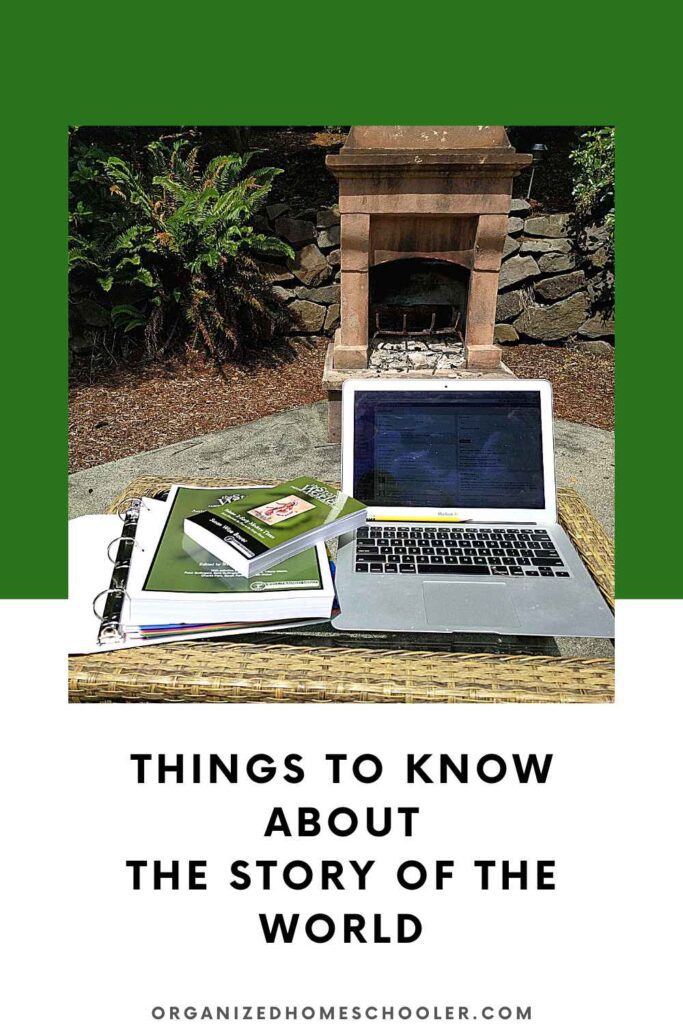
The Story of the World Curriculum is religiously neutral. Some people don’t like that religious historical events are mentioned. Some people wish there was more of a Christian worldview. Some people just like to argue about whether this curriculum is secular or not.
At the end of the day, you choose which chapters to read which your children. You can skip chapters or add in whatever you feel is missing.
The Story of the World follows a classical education framework. This framework assumes that students learn in three phases.
Grammar Stage – Kids in elementary grades are assumed to be in the grammar stage. This is a stage where younger children naturally learn and remember facts.
Logic Stage – Kids in middle school grades are considered to be in the logic stage of development. Kids this age are beginning to think independently. They also love to argue, which was definitely true of my kids in middle school.
Rhetoric Stage – High school students are in the rhetoric stage. At this point kids use the knowledge they gained in the grammar stage and combine it with their analysis and arguments of the logic stage. The result is a well-reasoned and communicated argument.
You do not have to be a classical homeschooler to use The Story of the World. My family considers ourselves to be eclectic homeschoolers. We pick and choose whatever seems interesting and appropriate at the time.
The Story of the World is intended for elementary and middle grade levels. People often wonder how the same book can be appropriate for a 1st grade level and an 8th grade level. The answer is in creating differentiated lessons.
A first grader will likely need a lot of parental help. They will need a parent to read the stories and guide the activities.
An eighth grader will be able to work independently at a deeper level. They might write papers on key events. They will likely do fewer of the related craft projects, but more of the research or timeline activities.
In reality, you can use The Story of the World for whatever grade level you want. However, as someone who has used this program and has homeschooled high school, I can say that this isn’t really appropriate for a high school world history credit.
The Story of the World is a world history course. There is occasionally US history because the US is part of the world. It is not a US history curriculum. However, you can certainly pull out certain America-centric chapters to include in an American history unit study.
Current events are not included. The last chapter of the final volume discusses the First Persian Gulf War of 1991. That isn’t ancient history, but it isn’t really current either. Thankfully, it is pretty easy to include current events in any social studies course. My family has watched CNN10 for years. It is just 10 minutes of news each day, so the highlights of current events are covered.
As an Amazon Associate I earn from qualifying purchases.
Keep reading . . .


