
The History of Money ~ Lesson Plans for Kids
I earn a commission from products purchased through links in this post.
When my kids are in 8th grade I give them the freedom to study anything they would like for history. After all, at that grade level, they have a strong historical foundation from their elementary years and don’t need to keep track of high school credits quite yet. This year my 8th-grade son asked to learn about the history of money.
This request shouldn’t surprise me. My son has been interested in money for a long time. He began investing when he was still in elementary grades and has mentioned that he might want to have a career that involves finance someday. Currently, he wants to be a quantitative analyst for a hedge fund.
As soon as he mentioned that he would like to learn about the history of money I started looking for a curriculum or lesson plans. However, there didn’t seem to be any homeschool curriculums or unit studies dedicated to this topic . . . at least that I found. Thankfully, it was not terribly hard to put together my own history of money unit study. I followed my standard formula for creating a unit study on any topic and started researching.
My son wants to study the history of computers in the second semester, so this history of money unit study only needs to span one semester.
I thought I would share this unit study in case you have an inquisitive child who is interested in money too.
The History of Money ~ Lesson Plans for Kids
This unit study covers 8 topics:
- The System of Bartering
- Commodity money
- Coins and paper notes
- Fiat money
- Representative money
- Electronic Banking
- Cryptocurrency and digital currency
- The future of money

Some of the above terms might be new to your child, so here are simple definitions.
Bartering – a form of payment based on the exchange of goods or services.
Commodity money – valuable items are used in exchange for goods or services. The item being exchanged has value on its own. Examples include tea, rice, and gold.
Coins and paper notes – paper and metal forms of money that are exchanged for goods or services. This is pretty familiar for most people.
Fiat money – government-issued legal tender
Representative money – government-issued money that has a standard of value because it is backed by a physical commodity
Electronic banking – a medium of exchange that happens electronically. Examples include debit and credit cards.
Cryptocurrency and digital currency – virtual currency of the modern world that is generated using secure computer encryptions. Examples of digital currencies include Etherium and Bitcoin.
As I mentioned, my son is currently in 8th grade. These activities worked well for him, but I think the assignments could be tailored for just about any grade level. Younger kids might need to have a parent do some of the reading. Older kids would likely need to use this as just one lesson plan in a series. I think it was the perfect amount of work for a fun middle school unit, but it is not enough to count as a high school credit.
Books About the History of Money
We used primarily 4 books throughout this unit study.
You Wouldn’t Want to Live Without Money by Alex Woolf


Last update on 2026-09-16 / Affiliate links / Images from Amazon Product Advertising API
You Wouldn’t Want to Live Without Money gives kids a quick introduction to a variety of money topics. It begins with bartering goods and services, touches on topics such as paper currency, central banks, the gold standard, and the future of money.
A Quick History of Money: From Bartering to Bitcoin by Clive Gifford and Rob Flowers

Last update on 2026-09-16 / Affiliate links / Images from Amazon Product Advertising API
This book lives up to its name. It really is a quick history of money. It touches briefly on just about every topic in the history of money. This includes topics such as Mesopotamian money, the world’s first coins, currency in Ancient Greece and the Roman Empire, the first central banks, hyperinflation, and financial crashes.
Everything Money: A Wealth of Facts, Photos, and Fun by Kathy Furgang

Last update on 2026-09-16 / Affiliate links / Images from Amazon Product Advertising API
National Geographic always makes great books for kids and this is no exception. It covers topics such as how money is made, how to spot counterfeit money, money around the world, money in the digital world, and coin collecting.
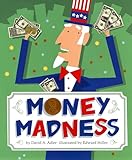
Money Madness by David A. Adler
Last update on 2026-09-16 / Affiliate links / Images from Amazon Product Advertising API
This book was a bit young for my son, but it still had good information so I included it. Money Madness encourages kids to think about the purpose, not the value, of money. Currency changes because the needs and wants of society change.
Websites
The U.S. Mint website is a great place to learn about the history of money. There are sections on coin programs, including coins with precious metals, medals, paper currency, and engraved prints.
The section we used most was found under the Learn tab. There we learned about the history of the Mint and coin production, production of money, and coin collecting basics.
Many educational resources can be found under the Kids Site heading. This area is also called the U.S. Mint Coin Classroom. Kids can play money games, watch short videos, learn about the life of a coin, and print out coin coloring pages.
The U.S. Currency website offers a virtual K-5 classroom. This includes:
- Currency Academy for Kids
- Lesson Plans
- Money Adventure Mobile App
The Currency Academy takes kids on an artistic tour of paper currency. There is even a page about the science that goes into designing and producing counterfeit-resistant paper notes.
The lesson plans section includes videos, vocabulary ideas, and math activities all centered around math.
The Money Adventure app is available on phones or tablets and teaches kids all about the security features of Federal Reserve notes. There are also lesson plans available to accompany the app.
The Federal Reserve is the backbone of the American financial system.
I like this website because the resources can be sorted according to the audience’s age group or topic. There are lesson plans available for a wide variety of economic topics such as inflation, the purpose of the Federal Reserve, warranties, etc. This is a good place to start for kids who are interested in monetary policy.
The Federal Reserve of Atlanta website offers lesson plans about the use of money. I like that the lesson plans are sorted by age group to make it easy to find appropriate activities.
There is a little about the history of money, but most of the lessons revolve around basic economic concepts, international finance, macroeconomics, microeconomics, and personal finance. If you have a student interested in money, they are likely to find these subtopics interesting as well.

Videos
Just a reminder that my son is in 8th grade. My husband and I thought these videos were appropriate for him, but please look through them to make sure they are suitable for your child.
A few years ago I took advantage of a sale and purchased an annual membership to Curiosity Stream. It has come in handy over the years. I often find videos to add to our homeschool lesson plans. My son watched these videos about the history of money on Curiosity Stream.
The Ascent of Money, episode 1 – This episode begins by explaining the global history of money. It touches on early mathematics, Renaissance Europe, and Incan precious metals.
Blockchain Revolution – This video is pretty short at around 20 minutes, but it gives a good overview of blockchain technology.
Amazon Prime
Amazon Prime is another place I find videos to complement our homeschool lessons.
Cryptopia: Bitcoin and the Future of the Internet – Cryptocurrency is big news in the finance world. It is no surprise that my son, who is interested in technology and finance, finds it fascinating. This video breaks down the pros and cons of this new form of currency. This is the newest video about cryptocurrency that we watched. Technology changes frequently, so if you are only going to watch one cryptocurrency video, I would recommend this one, released in 2021.
Banking on Bitcoin – Bitcoin was the first cryptocurrency that gained household name fame. This video, released in 2017, explains the technology and people behind Bitcoin.
Printable Resources
I didn’t use all of these printable resources with my son, but I wanted to share what I found.
Printable money – This printable play money is a fun addition to any math money lesson.
Coloring pages – Young kids might enjoy these money coloring pages.
The U.S. Mint offers quite a few printable resources related to money. We enjoyed the coin scavenger hunt and coin rubbing activities. There are tons more printable activities available, but most are geared toward younger kids.
Field Trips
I love incorporating field trips into our homeschool whenever possible, but in 2021 our field trip options were limited. Most government sites were closed to visitors. Thankfully there are a few virtual history of money field trips available.
American Numismatic Association – Did you know that numismatic is a Latin word meaning anything relating to or consisting of coins, paper currency, and medals? I didn’t until I came across this virtual tour.
This museum is located in Colorado Springs, but they have a wonderful virtual tour. It is easy to click around and see all of the signs and exhibits. These exhibits feature currency from various times in history. Some of the exhibits include:
- First coins from Asia Minor
- Ancient Greece coins
- Ancient Chinese coins
- Ancient Indian coins
- Paper currency from multiple European countries
- Native American currency – including animal skins and metal tool money
- US coins from various time periods -including Massachusetts Bay Colony coinage
- German notgeld
- Counterfeiting
British Museum – The British Museum is quite impressive. I first became aware of this museum when researching for our Ancient Egypt unit. They do a nice job putting exhibits online so we can take tours in different parts of the world without ever getting on a plane.
Some of the items on display include:
- Cowrie shells
- Chinese Ming banknote
- Suffragette-defaced penny

History of Money Sequence
This is the general sequence my son followed while learning about the history of money.
System of Bartering
A Quick History of Money p. 6 – 15
Bartering by Linda Brennan
Money Madness by David Adler
Commodity Money
A Quick History of Money p. 16 – 25, 44 – 55
Video – The Ascent of Money, episode 1 – Curiosity Stream
Coins and Paper Money
A Quick History of Money p. 26 – 43, 56 – 66
Everything Money p. 18 – 23, 30 – 31, 50 – 51
Video – Mussels, Coins, and Posting Lines – The Cultural History of Money – Amazon
Activity – Coin Rubbings
Activity – Coin scavenger hunt
Activity/Website – US Mint for Kids
Activity/Website – US Currency Life cycle
Virtual Field Trip – Atlanta Monetary Museum Tour
Fiat
A Quick History of Money p. 66 – 81
You Wouldn’t Want to Live Without Money
Representative Money
A Quick History of Money p. 82 – 87, 104 – 105
Electronic Banking
A Quick History of Money p 88 – 99
Everything Money p. 38 – 41
Credit cards
Cryptocurrency
A Quick History of Money p. 100 – the end
Video – Blockchain Revolution
Video – Cryptopia: Bitcoin and the Future of the Internet
Video – Banking on Bitcoin
The Future of Money
At this point in the unit, I asked my son to write a paper explaining his thoughts about the future of money.
My son found this history of money unit interesting. It also paired well with his personal finance curriculum.
As an Amazon Associate I earn from qualifying purchases.
Keep reading . . .
Unique History Books for Kids Who Hate History