
Personalized Homeschool Cooking Curriculum
I earn a commission from products purchased through links in this post.
Every time I share my son’s cooking class creations on Instagram stories I get a ton of messages asking which homeschool cooking curriculum we are using.
The answer always feels a little complicated because we are not using a commercial cooking curriculum or class. However, our specific plan won’t work for everyone either.
When my son mentioned that he would like to take a cooking elective in 9th grade I was very supportive. I think all high schoolers should learn their way around a kitchen. After all, it won’t be long until they will be responsible for fully feeding themselves.
I require my teens to take a cooking or home ec class and a personal finance class in high school. These are important life skills.
I looked briefly at a few cooking curricula for kids and cookbooks designed for beginners, but didn’t see anything that really fit what I wanted.

I wanted something that:
- Took food preferences and allergies into account – there is no use learning to cook something he doesn’t want to eat
- Was simple to implement
- Acknowledged varying skill levels
- Was extremely affordable
I ended up creating a personalized homeschool cooking curriculum for my son. This exact plan won’t work for everyone because we all have different food preferences. However, I am sharing it in hopes that it helps you design your own personalized cooking curriculum.
Personalized Homeschool Cooking Curriculum
Setting goals is the first step in planning any curriculum. My goals for this homeschool cooking curriculum are pretty simple. I want my son to learn to:
- Prepare a variety of meals
- Develop a few basic culinary skills, such as correctly and safely using chef, utility, paring, and bread knives
- Meal plan
- Demonstrate food safety
Learning knife skills and practicing food safety are discussions that will happen naturally during food preparation.
I specifically didn’t want a cooking course that spent a lot of time covering healthy food choices. These days, it seems like there are so many ideas on what healthy eating looks like and I don’t agree with all of them. We prefer to get our nutrition advice from educated nutrition professionals.
Besides, this has been an ongoing discussion since he was a toddler. However, if this is important to you, you can absolutely include it in your curriculum.

Types of Foods
Choosing the types of foods to include is what makes this homeschool cooking curriculum different from a commercial cooking curriculum.
I took a home-ec class in high school that included a semester of cooking. Each week, we made a new dish that was selected by the teacher. They were not foods that I enjoyed, so I don’t remember ever cooking any of those recipes outside of class.
I already knew the basics of cooking, so the class was a waste of time.
A personalized homeschool cooking curriculum doesn’t need to be like that. You and your student are in control. Make the foods that your family likes to eat. Choosing foods your student actually enjoys is a great way to keep them interested.
When I was planning the types of foods my son would cook, I found it easier to begin by thinking of broad categories. I thought of a few and then asked for his input. We came up with the final categories together.
Our categories are:
- Bread
- Breakfast
- Burgers
- Halloween Treats
- Pies
- Thanksgiving Foods
- Cookies
- Pasta
- Soups
- Italian Food
- Easter Treats
- Fish
- Mexican Food
You will notice that there are a few seasonal treats in the plan. My family loves to celebrate holidays with special foods, so this is a fun way to incorporate his cooking class.
Lesson Plans
Once we had our main categories listed, I began putting them in an order that made sense for my family.
I used a Trello board to keep everything organized. There is a list for every month. Within each list, I set up a card for each specific food or recipe.
We will make one recipe each week.
I intentionally did not fill in every single card for the entire year.
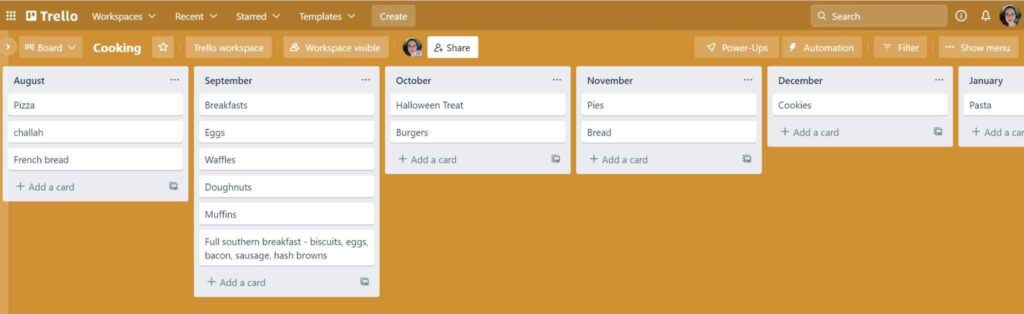
Full disclosure – this plan is evolving as my son develops his cooking skills. I realized after just one lesson that he enjoys making things from scratch and has no problem spending hours in the kitchen as long as he loves the final product. This will let us work at somewhat advanced levels.
Before each month begins, we discuss what he would like to make that fits in the categories. We talk about favorite restaurant meals, flip through cookbooks, and peruse Pinterest. This is the best way to allow space for his homeschool cooking curriculum to include some interest-based learning.
You will notice lots of empty space on the lesson plan, and that is okay. The plan still gives us a framework.
Here are our current lesson plans. Remember, this is just an example to help you create your own personalized cooking class.
August – Bread
- Pizza dough
- French bread
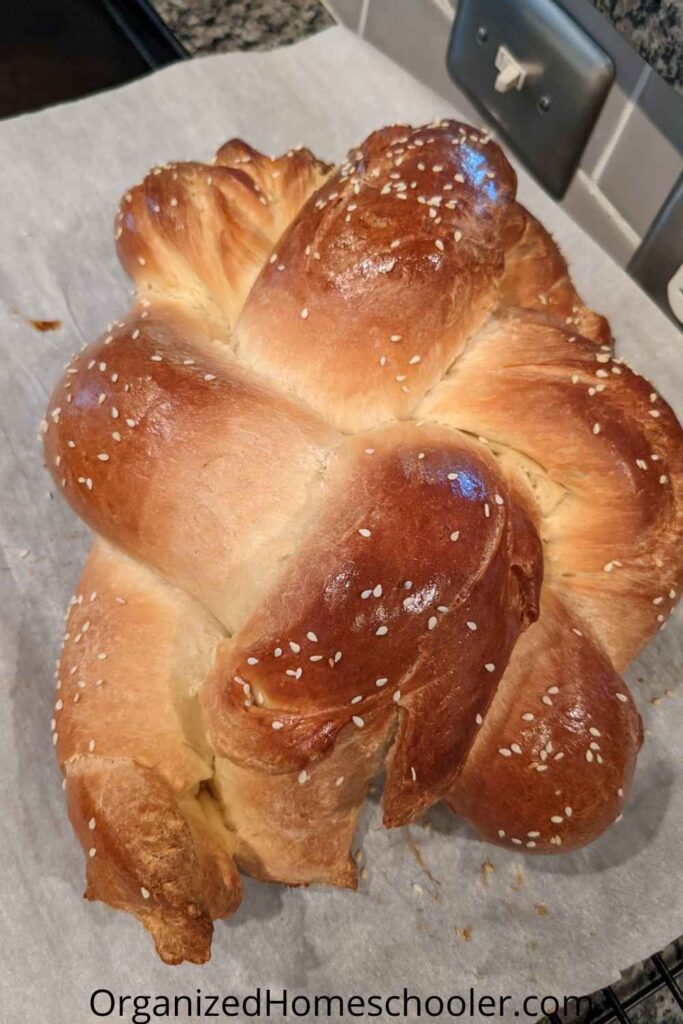
- Challah bread (My son found this recipe from Joshua Weissman. He said it was the best bread he has ever tasted.)
September – Breakfast
- Eggs, prepared two ways
- Waffles
- Doughnuts
- Full Southern breakfast – eggs, bacon or sausage, biscuits, gravy, and fruit (My husband is already looking forward to this delicious meal.)
October – Burgers and Halloween Treat
We haven’t chosen anything specific yet, but I am excited to make special Halloween treats together. Now that my kids are all teens, one of our favorite Halloween activities is staying up all night watching a Halloween movie marathon. I’m looking forward to incorporating these treats into our family tradition.
November – Thanksgiving Foods
December – Cookies
January – Pasta
February – Soups
This will be a great month to learn to use the Instant Pot and the slow cooker.
March – Italian Food
April – Fish and Easter Treats
My son has requested that we spend at least one week of April learning to make sushi.
May – Mexican Food
Frequently Asked Questions
What grade levels can use this homeschool cooking curriculum?
I would use this plan for middle school students or high school students because they are old enough to have quite a bit of independence in the kitchen. When my kids were elementary students, they just helped me in the kitchen whenever they were interested. This is a great high school elective.
Is there a supply list?
No, I didn’t include a supply list because your recipe choices will be different from mine. Other than ingredients, we are just using the supplies we already own.
Where are you finding the recipes?
So far we have used a recipe I found on Pinterest, a favorite cookbook, and YouTube. Once we know what we are going to work on the next week, my son and I both start looking for recipes that sound good.
How are you grading this course?
I’m not using any specific evaluation tools. If he is engaged and tries his best, he gets an A. If he isn’t engaged and trying his best, then we will keep redoing the lessons until he earns an A.
Can you recommend any nutrition education programs?
I have never used any specific programs to discuss nutrition with my kids. It has just been an ongoing discussion since they were little. I have seen a few homeschool nutrition education programs on the market, but I can’t recommend any since I don’t have experience with them.
Randi, from Peanut Butter Fish Lessons, recently posted about her homeschool cooking science lessons. It looks like a great plan!
I hope this helps you create your own personalized cooking course. Giving your own kids a cooking lesson does not need to be complicated.
Keep reading . . .
- My Favorite Homeschool Personal Finance Curriculum
- A Guide to High School Electives
- How to Create a Homeschool Curriculum
- Useful {and Fun!} Homeschool Co-op Class Ideas
- High School Child Development Course
- Harlow’s Harvest Review
As an Amazon Associate I earn from qualifying purchases.