
All About Math 5 Review: Complete Guide
I earn a commission from products purchased through links in this post.
Recently, All About Learning Press published a new level of their popular math curriculum, All About Math 5. I have been a fan of All About Learning since my homeschooling elementary days when my kids used the All About Spelling curriculum. My kids are now both full-time college students, so that gives you an idea of how long I have followed this curriculum.
I have been curious about the new math curriculum since I saw Level 1 hit homeschool bookshelves, but my kids were too old for the program, so I never had an excuse to check it out. However, I was recently asked if I wanted to review the newest level. I jumped at the chance to get my hands on a copy. I was gifted the All About Math Level 5 curriculum for review purposes.
Before I get into the All About Math 5 review, I think it is helpful to explore the science of math. Lately, the science of reading has been making headlines, but there is little said about the science of math. Understanding how students learn is important when deciding how to teach math skills. Research shows that students benefit from:
- Explicit instruction – Explicit instruction is an explanation of the concept. After an explanation, students and the teacher work through guided practice problems, with the teacher modeling the procedure. Next, the students practice math problems independently. Finally, the students explain the process.
- Consistent, clear vocabulary – Using consistent vocabulary across grade levels reduces misunderstandings and confusion.
- A variety of teaching methods – Explicit instruction is important, but so are math manipulatives. Using multiple teaching methods can improve conceptual understanding.
- Progressing through skills systematically after demonstrating proficiency – Following a systematic skill progression reduces learning gaps and builds a strong foundation for future knowledge. It also reduces cognitive load.
- Conceptual understanding and procedural fluency being taught together – People naturally use concepts and procedures together to solve real-world math problems. Understanding the concepts makes the procedures more intuitive, and procedural fluency makes the concepts clear.
Now that we are clear on how students learn math, let’s talk about All About Math 5.
All About Math 5 Review
All About Math Curriculum
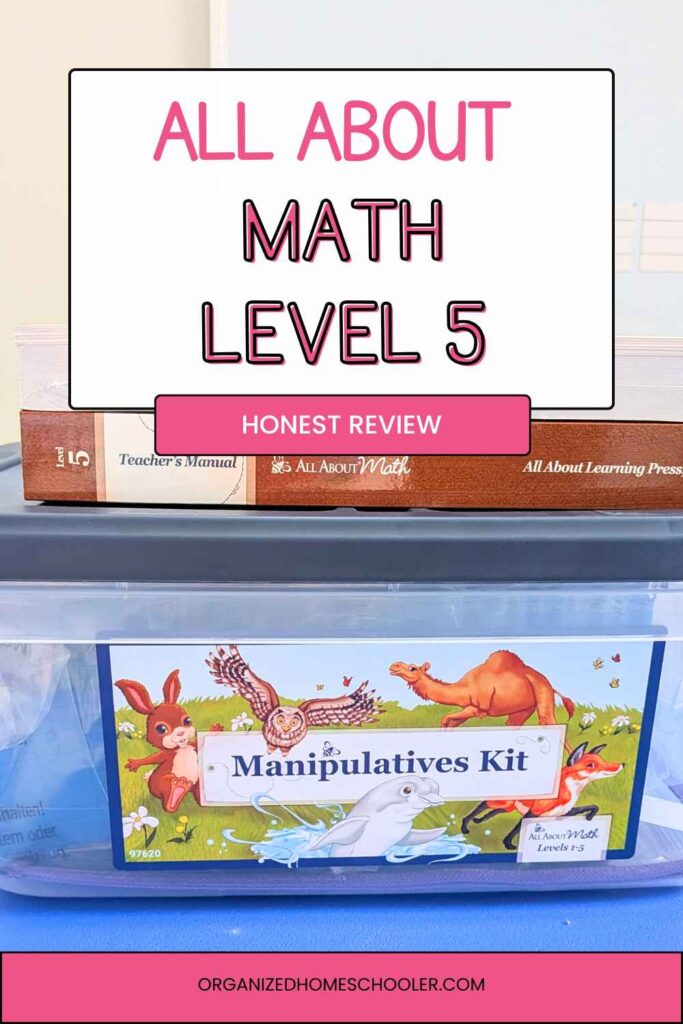
All About Math 5 is the newest math curriculum from All About Learning Press.
The All About Math 5 curriculum includes:
- Teacher’s Manual
- Student Packet
- Manipulatives Kit
All About Math 5 Teacher’s Manual
The All About Math Level 5 teacher’s manual is divided into several sections:
- Preparing for Level 5
- Complete Step-by-Step Lesson Plans
- Appendices
The teacher’s manual contains the bulk of the instructional material, so it is not optional. You will be lost without it, and your students will miss out on important explicit instruction. You can view a sample of the All About Math 5 teacher’s manual.
Preparing for Level 5
The first section of the teacher’s manual explains how to use the curriculum. It explains how to get started, making sure this is the right level for your child, the All About Math method, and provides information about the lessons and manipulatives.
Complete Step-by-Step Lesson Plans
Each lesson follows the same general format:
- Objective
- Materials needed
- Math vocabulary
- Before you begin teacher notes
- Review
- New teaching
- Activity sheet
- Answer key
- Math reflection
- Optional extended practice
- Calina’s Math Fun
- Track your progress
The lessons are scripted and extremely detailed. You will never need to think of an example to use or what to do next because it is written for you. Progress monitoring activities are sprinkled throughout the book to act as assessments.
Appendices
Typically, I skip the appendices at the end of a teacher’s guide, and I suspect I’m not the only one who does that. However, there are a few pages in the All About Math 5 appendices that are worth checking out. In addition to the scope and sequence, you will also find several answer keys, teaching strategies, a units of measurement glossary, and a regular glossary with math vocabulary terms. Those are helpful if you find yourself googling how many tablespoons in a cup, how many feet in a yard, or the definition of the distributive property.
All About Math 5 Student Packet
The All About Math 5 student packet contains several key parts of the program:
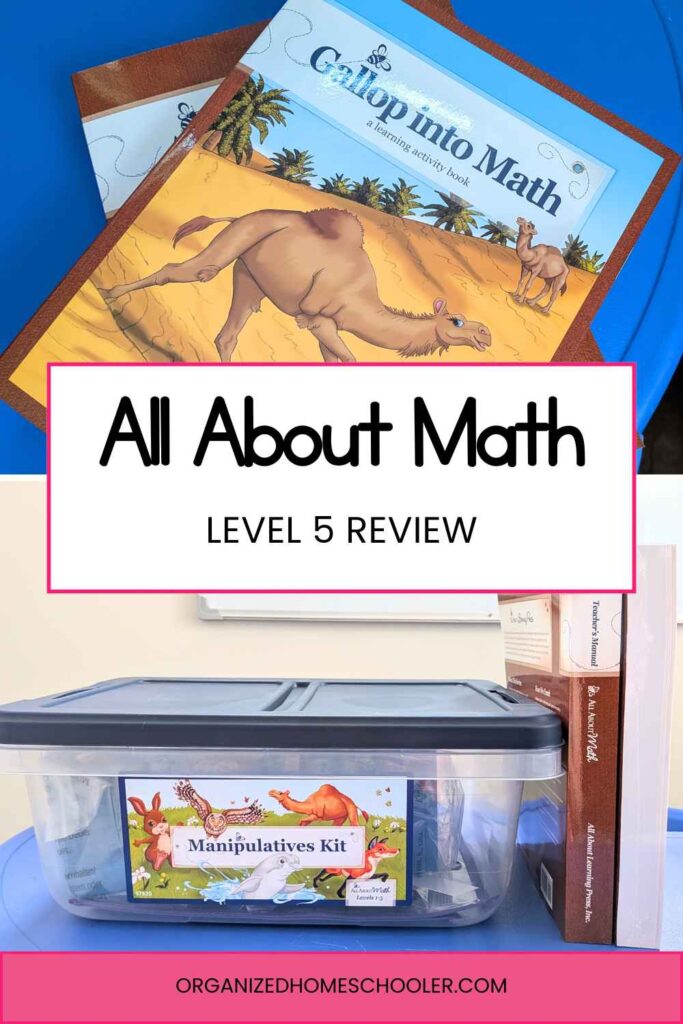
- Gallop into Math Activity Book
- Calina’s Math Tools
- Stickers for Progress Chart
You can buy the activity book and stickers separately, but the student packet is the only way to access Calina’s Math Tools.
Gallop into Math Activity Book
Gallop Into Math is the learning activity book that correlates with the Level 5 teacher’s manual. Some of the pages are typical workbook pages, and students will solve math problems with a pencil. Other pages involve cutting out paper so you can move the pieces around or play games. All of the pages are perforated so they can be easily removed from the workbook. You can view a sample of the activity book.
I would set it up the same way I set up All About Reading – in a binder with page protectors. I would remove all of the workbook pages and store all of the pages for each lesson in a page protector. If your student uses the paper protector from the manipulatives kit, you can reuse the pages with future students. You can remove all of the pages before beginning the curriculum or right before you teach a lesson. Personally, I would make sure I had everything pulled one to two weeks in advance. This makes sure you have everything you need for a lesson, but you are not spending much time preparing.
Calina’s Math Tools
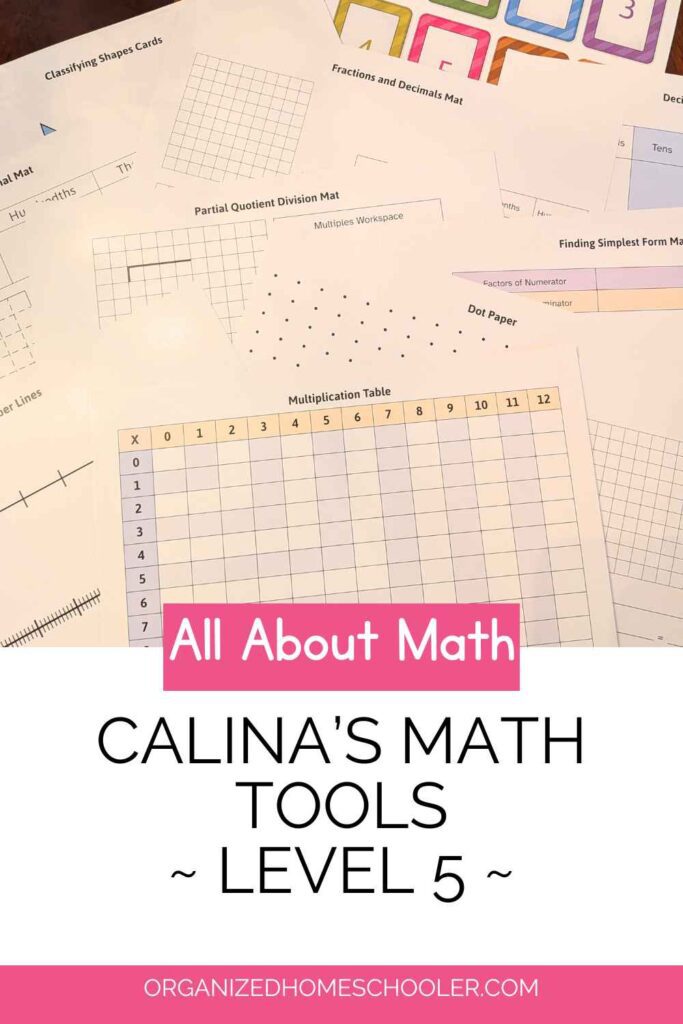
Calina’s Math Tools are math mats, cards, and charts printed on thick glossy paper.
The math mats include:
- Multiplication Table
- Dot paper (like a flat geoboard)
- Partial Quotient Division Mat
- Fractions and Decimals Mat
- Decimal Mat
- Decimal Number Lines
- Finding Simplest Form Mat
- Grid Paper
- Large Grid Paper
- Decimal Division and Multiplication
- Tenths and Hundredths Grids
- Table and Blank Grid
- Open Number Line
- Analyzing Patterns Mat
- Table and Labeled Grid
- Bar Graph Template
- Dot Plot/Line Plot Template
The cards include:
- Classifying Shapes Cards (The teacher script and student answer are printed on the back.)
- Number Cards
- Shape Cards
- Coin Cards
- Make a Cube (This is more of an activity than a simple card.)
The charts include:
- Classifying Quadrilaterals Chart
- Decimal Place Value Chart
- Metric Conversions Chart
These mats, cards, and charts provide a way for students to interact with the math concepts, other than just a worksheet. I would store these in page protectors in a binder. Can you tell that is one of my favorite ways to organize All About Learning products?
All About Math 5 Stickers
The stickers included in the student packet match the camel theme on the progress chart. At the completion of each lesson, students place a sticker on the chart. The stickers are cute, and I like that they fit the theme, but if you lose them or are working with multiple students, any small, round sticker will work.
All About Math Manipulatives Kit
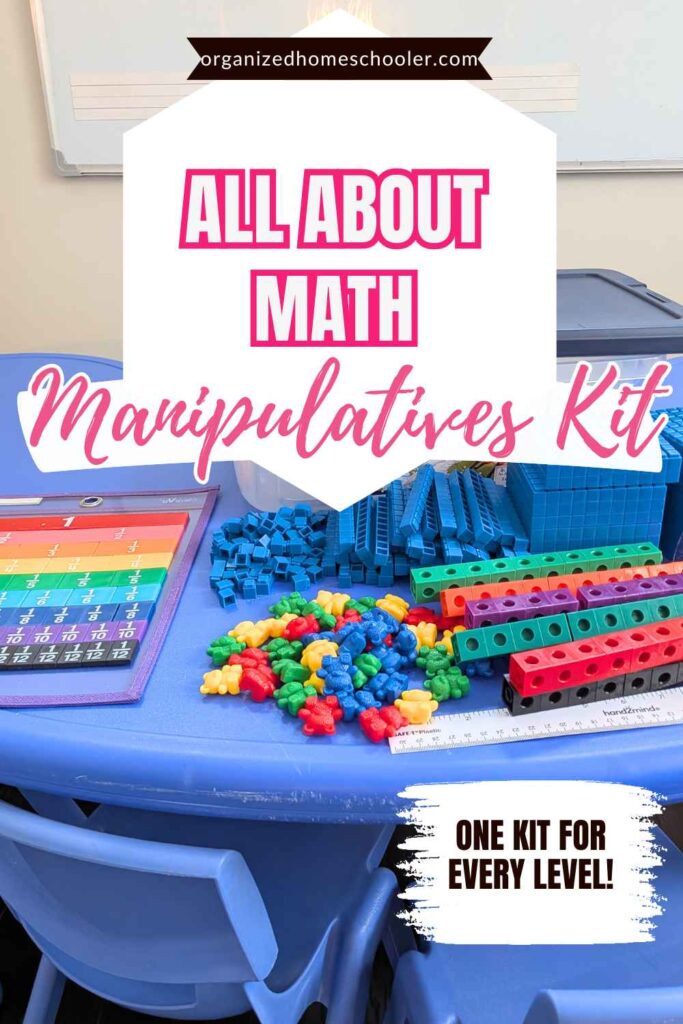
I love teaching with manipulatives, so I was most excited to check out the math manipulative kit.
- 100 Base Ten Units
- 50 Base Ten Rods
- 10 Base Ten Flats
- 1 Base Ten Cube
- 40 Baby Bear Counters
- Rainbow Fraction Tiles
- 10 Snap Cubes
- 50 Two-Color Counters
- Flexible Ruler
- Clear Protractor
- Clear Paper Protector
The manipulative kit is intended to be used at every level of All About Math and only needs to be purchased once. The kit arrives in a sturdy plastic bin with a latched lid. Each manipulative is in its own clear zipper bag so everything stays organized. The bags are also labeled. That is a small detail, but I appreciate that it is easy to clean up and put everything back in the correct bag.
Hand2Mind supplies the manipulatives, and I was impressed by their quality. I frequently purchase other Hand2Mind products for my kindergarten homeschool class because I know they will last.
My Thoughts About All About Math 5
If you have read about my love of All About Spelling, it won’t surprise you that I am also a fan of All About Math. I appreciate when homeschool curricula create resources that follow best educational practices while also making it easy for parents. My kids were finishing high school when All About Math was published, but I wish I had it when they were younger. My daughter liked using hands-on materials, and my son liked a challenge. I think they both would have enjoyed this homeschool math curriculum.
Some of the things I love about All About Math 5 are:
Follows the Science of Math
The All About Learning Math 5 curriculum follows the techniques supported by the science of math research.
The teacher’s manual is scripted, which means that students are receiving explicit instruction during every math lesson. Scripting also ensures that children are being exposed to consistent, clear math vocabulary. I know some homeschool families are not fans of scripting because they feel it limits their teaching. I disagree. Scripted lessons are a teaching tool.
Each lesson teaches concepts through multiple educational methods. Students will hear the instruction, see the examples, use math manipulatives, and solve problems using the math mats and charts.
The scope and sequence is designed to systematically guide students through math concepts. They are developing the proper scaffolding to support higher learning. Progress monitoring activities and frequent review opportunities help ensure that students are not passing on without understanding the material.
You are not expected to complete a lesson each day. There are 46 lessons and roughly 180 days of school in a typical school year. That means that you can spend 3-4 days on each lesson. You will probably find that your child progresses through some lessons quickly and other lessons take a little longer. Take your time working through the examples, doing the optional activities, and using Calina’s Math Tools whenever your child doesn’t seem confident. The math reflections are a great way to determine if a student has truly mastered the material or if they have misunderstood a concept. Correct any misunderstandings as soon as you notice them.
Conceptual math teaches why we solve math problems a specific way. Procedural math teaches students how to solve math problems. All About Math teaches conceptual and procedural math. For example, in a lesson about solving problems about perimeter and area, students are taught the definitions of each term and given a chance to model them with linking cubes. Then they are taught the steps to solving the problems.
Easy for Parents
All About Math 5 is well organized, making it easy for parents. It is designed to be open and go, and I think that is accurate. At this level, students can help cut out any paper cards or game pieces while parents take a few minutes to review the lesson.
The script walks you through how to review previous lessons, teach new concepts, and determine whether your student has mastered the material.
The manipulative kit has everything you need to teach the lesson so you never have to stop and search for a specific number of dried beans, buttons, or certain coins. You won’t have to skip a lesson or miss out on including hands-on activities because you have everything you need.
Short Lessons
All About Learning Press suggests keeping math lessons to about 20 minutes a day. This has a few benefits:
- Maintain attention
- Easier to fit into the homeschool day
Maintain attention
The average attention span of an upper elementary age student is 16-30 minutes. Keeping lessons to 20 minutes a day fits nicely in those guidelines. Students can focus and work hard, knowing that soon they will get a break or move on to another activity. Short lessons also let you stop before students reach a frustration point, improving attitudes about math and schoolwork.
Easier to Fit Into the Homeschool Day
Homeschool parents are busy. They are frequently teaching multiple children at different levels while also taking care of other responsibilities. Short lessons make it easier to dedicate all of your focus to teaching for a block of time.
I do wish that the lessons were organized as 180 different lessons and scripts because I am a Type A, Enneagram 1, person who has trouble stopping partway through a lesson. I would find it helpful to have clear start and stop points in each lesson. Maybe that is just me, though. The current format allows for plenty of flexibility.
Frequently Asked Questions About All About Math 5?
How much prep time is required?
All About Math 5 requires very little teacher prep time. Before each lesson, you will want to read the teacher tips in the tan box, briefly read through the lesson, gather the materials, and tear out the lesson pages from the student activity book. Some of the lesson pages require activities to be cut out, but upper-elementary students can do that while you are reading through the lesson. If you do all of this right before the lesson, that is about 5-10 minutes of prep time each lesson. Remember, your student will likely complete 2 lessons a week.
How much time is required each day?
It is recommended that you spend 20 minutes a day, five days a week, teaching math. You do not need to finish an entire lesson in one day.
If you want to spend more time on math each day, you can progress through the lessons faster or add in math games. I liked to incorporate math games and activities in my elementary math lessons because it was a fun way to review skills.
Is the manipulative kit necessary?
You need manipulatives for the lessons. However, if you already have these specific manipulatives at home, you do not need to purchase the kit from All About Learning.
Can I transition from another math curriculum to All About Math 5?
If a curriculum is not working for your family, you can always switch. Elementary math skills are important and set the foundation for all higher math skills, so it is worth finding the right one.
Every math curriculum teaches concepts in a slightly different order, so I recommend using the placement test to make sure that your child is working at the correct level.
How do I know if All About Math 5 is the right level?
If your student completed All About Math 4, they are ready for level 5.
If your student is new to All About Math, administer the placement test to make sure the material is not too easy or too difficult. To give your student the placement test, print it out and ask your child to complete the 23-question assessment. You can read the questions, but don’t jump in and offer help. The goal of the assessment is to see what your child has mastered, not what you can explain and teach in the moment. If your student gets at least 21 questions correct, they are ready for All About Math 5.
Do I need anything else beyond the teacher’s guide, student packet, and manipulative kit?
The only items, beyond what is included in the curriculum, that you will need are a dry-erase board, dry-erase marker, and folder or binder to store the student packet items. If you homeschool, there is a good chance those items are already in your house.
What grade level is All About Math 5?
The official answer is that grade levels are not correlated with All About Math levels. A student is ready for level 5 when they either complete All About Math Level 4 or test into it via the placement test.
However, I think most people want a general starting point. To answer this question, I turned to the North Carolina Standards of Learning. I compared the scope and sequence of level 5 to the standard course of study for upper elementary grade levels. In North Carolina, some of the learning objectives are completed in 4th grade while others are completed in 5th grade. If your child is in or around that grade range, I recommend taking the free placement test.
I hope this post helps you decide whether All About Math 5 is right for your family.
Keep reading . . .