
Math with Confidence Kindergarten: Honest Review
I earn a commission from products purchased through links in this post.
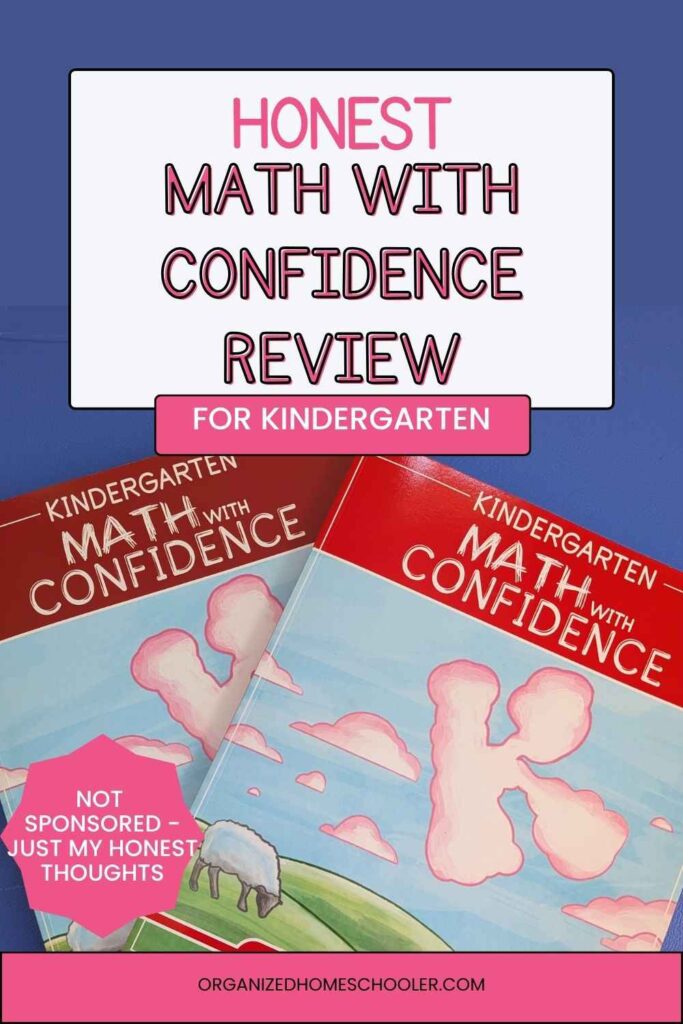
Math with Confidence Kindergarten math curriculum is one worth considering because it keeps lessons short and manageable. I recently purchased the Kindergarten level because I’m currently deciding which math curriculum to use in my kindergarten homeschool class and wanted to take a closer look at the Math with Confidence Kindergarten curriculum.
After looking through the actual curriculum, my overall impression is positive. I think Math with Confidence is a strong kindergarten math curriculum with a thoughtful approach to building foundational math skills. That said, there are a few things I would change.
I homeschooled my children K-12 for 15 years. I also spent the last few years teaching kindergarten. My experience as both a homeschool mom and classroom kindergarten teacher gives me a unique perspective on homeschool curriculum.
In this Math with Confidence review, I’ll take a closer look at the lessons, materials, and teaching approach so you can decide whether it’s a good fit for your homeschool. I think Math with Confidence is especially well suited for families who want quick, hands-on math lessons without spending a large portion of the homeschool day on math.
Math with Confidence Kindergarten: Honest Review
Included in Math with Confidence Kindergarten
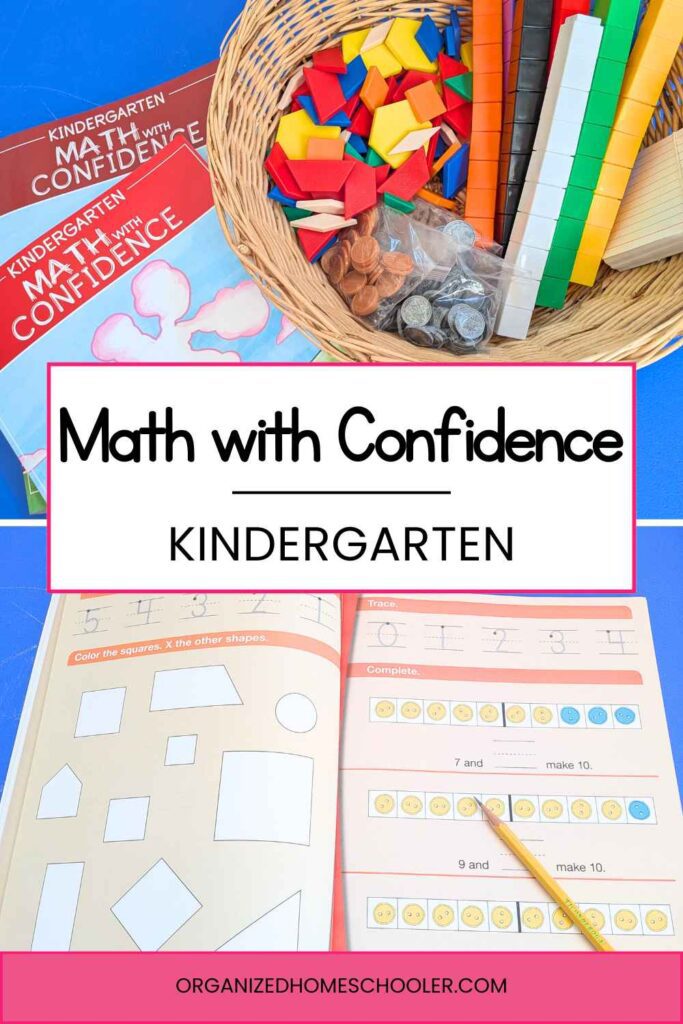
The Math with Confidence Kindergarten level includes:
- Student Workbook
- Instructor Guide
The student workbook contains typical math workbook pages. Every page begins with a number tracing section. Then students complete a short activity, such as coloring specific shapes, matching a number with the correct number of items, and solving basic addition and subtraction equations.
The Math with Confidence Kindergarten Instructor Guide is crucial to successfully using this math curriculum. The Instructor’s Guide includes:
- Weekly overview
- Daily lesson plans
- Scope and sequence
- Suggested math picture books
- Materials list
- Blackline masters
- Ten-frame blackline master
- Play money blackline master
- Pattern block template blackline master
- Double ten-frames blackline master
- Number examples blackline master
- Centimeter squares blackline master
- 100 Chart blackline master
Not Included in Math with Confidence Kindergarten
Math with Confidence Kindergarten requires a few hands-on materials that are not included in the curriculum. It is recommended that you put together a math kit so everything you need is ready to go. The math kit should contain:
- 100 Small counters such as teddy bear counters or dried beans
- Pattern blocks
- Coins – 20 pennies, 20 nickels, and 10 dimes (plastic replicas are available, but it is generally cheaper to use real coins)
- 200 Blank index cards
- Blank paper
- Pencils
Some lessons require items that are not part of the math kit, but those are basic household items such as stuffed animals, tape, pitcher of water, egg carton, etc. There are no expensive manipulatives required.
Related: Best Math Manipulatives for Homeschool
Lesson Flow
Every Math with Confidence Kindergarten lesson follows the same sequence:
- Review and warm-up
- Activities
- Workbook page
Review and Warm-Up
The review and warm-up are quick activities that can help children get ready for the math lesson. These activities include things like holding up fingers to count, math memory games, putting number cards in order, and following directions.
The review and warm-up only require 3 – 5 minutes, but I think some kids will really enjoy some of the warm-up games and might want to play them longer.
Activities
The hands-on activities portion of the lesson is where the instruction happens. The lessons are scripted, but you can put the instruction into your own words. The script does a good job of naturally including math vocabulary, which is helpful. The activities help young children develop a strong understanding of math concepts.
The daily activities portion of the lesson takes 5 – 10 minutes.
Workbook
Each lesson has one full-color student workbook page. Kindergarten students will need you to read the directions and check their work, but they can likely complete the page independently.
The workbook portion of the lesson is quick and only requires 2 – 5 minutes.
What I Like About Math with Confidence Kindergarten
Easy to Teach
Math with Confidence Kindergarten is truly an open-and-go curriculum. The lessons are scripted, making it easy to teach the lesson knowing that all math concepts and vocabulary are being taught. The curriculum lives up to its title; you will be able to teach math with confidence.
No Prep Work
The only prep work required is assembling your math kit. That will take less than 10 minutes and only needs to be done once. There is nothing to cut out, assemble, or set up before the Math with Confidence Kindergarten lessons.
Daily Review
Daily review is so important in math instruction. It increases neural pathways and reduces cognitive fatigue. This makes mastery of the material easier. I also appreciate that the review does not involve worksheets.
Lots of Hands-on Activities
Hands-on lessons are important for kindergarten students. Some of the benefits include:
- Better engagement and participation
- Develop a deep conceptual understanding
- Stronger retention
I really appreciate that every single lesson includes at least one hands-on activity. I have watched many kindergarteners understand a concept once they start moving teddy bear counters or pattern pieces. Students will have lots of practice opportunities between the daily review and the hands-on lessons.
Short Lessons
While I am not someone who thinks a kindergarten homeschool day should only take 30 minutes, I do appreciate the short lessons in Math with Confidence Kindergarten. The concepts are taught in an efficient manner without any wasted time or busy work. Kindergarten attention spans are short, and homeschool parents are busy, so short, focused lessons are helpful.
Inclusion of Math Picture Books
I love including books in lessons whenever possible. My kindergarten students loved when I called them all to the carpet for a story at the end of math class. Books can help children connect the math concepts with real life.
Some of my favorite math picture books for kindergarteners are included in the book list:
- Ten Black Dots by Donald Crews
- Domino Addition by Lynette Long
- Left, Right, Emma! by Stuart J. Murphy (Stuart J. Murphy has a talent for writing delightful math picture books.)
Related: Fun Elementary Math Picture Books
Combines Mastery with Spiral Review
Sometimes people ask me if I think we should teach math through a mastery approach or a spiral approach; honestly, we need to do both. New concepts are presented in grouped units, so children get consistent instruction and practice until they master a skill. Every new lesson builds on prior knowledge. Then concepts are occasionally presented for review to keep skills strong. This approach, combining mastery and review, creates confidence-building lessons.
Math with Confidence Kindergarten does a great job combining mastery with spiral review. At the end of every unit, there is a checkpoint. The checkpoint is intended to help parents determine whether their child is ready to progress to the next unit or if they need more practice to master the skills. It isn’t a test. Instead, it is a list of skills that parents can read and reflect on whether their child truly knows the material. If they are ready, they move to the next unit and will occasionally review the skills during daily review. If they are not ready, there are suggested activities to practice.
4 Day Week Plan
Math with Confidence Kindergarten suggests completing a math lesson 4 days a week. This allows one day for homeschool co-ops, field trips, or park days.
If you prefer to do math 5 days a week, there are optional ‘Weaving Math into Everyday Life’ weekly suggestions. That activity, combined with the math book of the week, can fill in the fifth day.
Affordable
Everyone has a different definition of affordable, but compared to many kindergarten homeschool math curricula, Math with Confidence Kindergarten seems very reasonably priced. You will need to add in a few items to your math kit, but those are minimal and also reasonably priced.
What I Don’t Like About Math with Confidence Kindergarten
Number of weeks
Math with Confidence Kindergarten contains 128 lessons. That is enough lessons for 32 weeks a year, at a pace of 4 lessons a week. However, a typical school year is 180 days or 36 weeks. I wish this curriculum had an additional unit or two to help it last the entire school year. Finishing math a month before the end of the school year is not ideal, and it puts parents in an uncomfortable situation. Do you just not do math for the remainder of the school year, or do you start the next level and then take a break after a month?
No Placement Test
I really wish Math with Confidence offered placement tests. Placement tests would make it easier to know whether a level was the correct level for your child.
Missing Specific Skills
When I was looking over the scope and sequence, the table of contents, and the lessons, I noticed a few skills seem to be missing. Based on North Carolina kindergarten standards of learning and other kindergarten math curriculum options I have used, the following skills are missing:
- Counting forward from a number other than 1 (for example, counting forward to 30 beginning at 18)
- Specific shapes – hexagon, cubes, cones, and spheres
- Graphing or any kind of data collection
I have no doubt that these skills are included in other Math with Confidence grade levels, but it did surprise me that they are not included in the kindergarten level.
Calendar Skills
I was also surprised that there is no mention of calendar time. In fact, calendar skills are the last unit in the curriculum. This is intentional. The author says she put the calendar skills unit at the end of the curriculum because kids need to be able to recognize numbers up to 31 and be able to understand an abstract concept like time. I have taught many kindergarteners how to understand a calendar, and they never had difficulty, even at the very beginning of the year.
Related Post: Kindergarten Calendar Wall: Great Options for Home
Misprint
This is such a small issue; I wasn’t sure if I should even mention it. However, I decided to mention it so it doesn’t surprise you if you choose to purchase this curriculum. My Instructor’s Guide is missing page 384. Page 390 is where page 384 should be, and also where page 390 should be. I only noticed this because I was hoping to read more about why months and days of the week, time of day, and how to read clocks to the hour are in the very last unit of the curriculum. I was able to find the information online, so it wasn’t a problem, but it could be frustrating if you were looking for the Weaving Math into Everyday Life activity for that week.
My copy was printed in January 2026 by Bradford & Bigelow.
Frequently Asked Questions About Math with Confidence Kindergarten
How much time does Math with Confidence Kindergarten take?
The Instructor Guide says that the lessons should take roughly 15 minutes a day, and I think that is accurate for most students. Some kids will work through a little faster, and some kids will take a little more time.
Who is Math with Confidence Kindergarten best for?
Math with Confidence Kindergarten is best for families who want short math lessons without sacrificing hands-on activities or workbook pages.
I think it could be a really good fit for young children who do not feel confident in math or who do not enjoy math. Math with Confidence will help them build confidence while also enjoying math. The frequent games, hands-on activities, and picture books are hard to resist.
I do not think it is the right curriculum if your child is confident and has a strong grasp of the included math skills.
How do I know if kindergarten is the right level?
Math with Confidence Kindergarten does not offer a placement test. Children do not need to complete a formal preschool math program. Kids are ready for the kindergarten grade level if they can count to 10 and hold a pencil. If they can count to at least 10, write numbers 1 – 10, identify basic shapes, and solve basic addition and subtraction problems, they might be ready for first grade math
How much does Math with Confidence cost?
The Math with Confidence Student Workbook and Instructor Guide cost around $65 for the print version. It is available on Amazon, but I purchased the bundle from my local Raleigh homeschool store for the same price. Well-Trained Mind Press carries the print version for $48 with free shipping for orders over $150. They also sell digital copies for $42.
Is the Instructor Guide Necessary?
Absolutely. The teaching happens with the review and hands-on activities that are planned in the instructor guide. The workbook is not a curriculum on its own.
Is Math with Confidence hard?
Kate Snow, the curriculum author, states that Math with Confidence is ‘middle of the road’ in terms of difficulty. I think that is on the easy side of kindergarten math curricula. I don’t think many kindergarten-level students will find the material too hard, but I do think some may find it too easy.
Is Math with Confidence worth it?
The answer to this question always depends on what you want out of a curriculum.
Do you want a kindergarten math curriculum that is easy to teach and features short lessons? Then it’s worth it.
Do you want a kindergarten math curriculum that will increase confidence for you and/or your child? Then it’s worth it.
Do you want to end math struggles by including fun activities? Then it’s worth it.
Do you want an affordable curriculum that will create a solid foundation for future math levels? Then it’s worth it.
Do you want a rigorous kindergarten math curriculum? Then this is not worth it.
Math with Confidence at a Glance
- Grade: Kindergarten
- Subject: Math
- Teaching style: Hands-on/conceptual
- Lesson length: 15 minutes
- Parent involvement: High
I hope this Math with Confidence review helps you decide whether this is the right kindergarten math curriculum for your family.
Keep reading . . .
- Homeschool Kindergarten: Your Complete Guide to Teaching Kindergarten at Home
- Guide to the Best Kindergarten Homeschool Curriculum Options
- Detailed All About Reading Level 1 Review
- All About Reading vs Teach Your Child to Read in 100 Easy Lessons
- All About Math Level 5 Review
- Homeschool Curriculum Reviews
As an Amazon Associate, I earn from qualifying purchases.