
The Best Math Manipulatives for Homeschool
I earn a commission from products purchased through links in this post.
Math manipulatives are more than just toys. They are important math tools that help students experience math concepts in a way that a worksheet or textbook simply can’t. Students are able to understand mathematical concepts faster through hands-on exploration.
Why Use Math Manipulatives
1. They Build Number Sense
At its most basic explanation, number sense is the ability to work with numbers. It is the foundation upon which all other math skills are built. Number sense is made up of:
- One-to-One Correspondence – This is the ability to match one object with one counting word while counting. They also understand that each object is only counted once. For example, counting a row of flowers one by one.
- Cardinality – This is the ability to understand that the last number counted represents the number of items in the group. For example, if a child counts 4 strawberries on their plate, they understand that there are 4 total strawberries without needing to recount.
- Subitizing – This is the ability to instantly recognize a group of items as a number without needing to count each individual item. For example, being able to identify the 4 on a dot cube without needing to count the individual dots.
- Magnitude – This is the ability to understand the size of numbers in relation to other numbers. For example, knowing that 8 is more than 5.
- Composition and Decomposition – This is the ability to put numbers together and break them apart in different ways while understanding that the total number doesn’t change. For example, connecting 10 linking cubes and then breaking them into 8 and 2, 7 and 3, 5 and 5, etc.
- Base-Ten Understanding – This is the ability to understand that our math system is based on groups of 10. For example, 100 is 10 groups of 10.
Physical manipulatives allow children to physically count, group, compare, and move objects as they learn. Instead of memorizing that 5 is greater than 3, they can see and feel the difference.
2. They Make Abstract Concepts Concrete
Math can feel very abstract, especially for younger students. Children learn math concepts by manipulating items. Objects that help students hold, move, or see how numbers relate will help them learn abstract ideas much faster.
While there are many great math textbooks, most students, especially young students, can not learn through just a written explanation. The use of math manipulatives provides an additional way for students to learn.
For example, instead of memorizing that one-half is larger than one-fourth, children can compare fraction pieces side by side. When children can see what is happening, the concepts are much easier to understand.
3. They Make Learning Fun
Math manipulatives are important learning tools, but they feel like play. There are a few benefits to including play in math instruction:
- Enhances Memory – Positive emotions have a positive impact on various areas of the brain, including the amygdala. This increases memory consolidation and recall.
- Boosts Engagement – Students naturally stay engaged in activities longer if they are enjoyable.
- Increases Motivation – Children who enjoy their math lessons are likely to explore math activities outside of lessons. They are less likely to shy away from math activities because they believe they can do it.
This isn’t just my opinion. These benefits are based on neuroscience
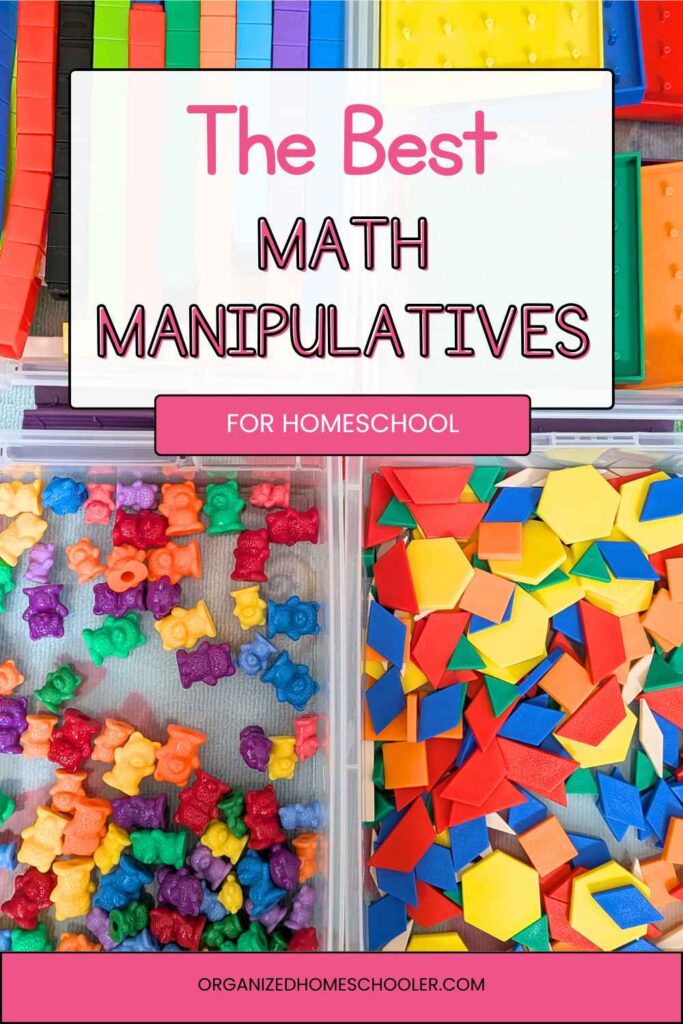
The Best Math Manipulatives for Homeschool
Counters
- Bears
- Dinosaurs
- Sea life
- Farm animals
- Mini erasers
- Chocolate chips
- M&Ms
Skills:
- Counting
- One-to-one correspondence
- Subitizing
- Sorting
- Creating patterns
- Comparing quantities
- Addition and subtraction
- Graphing
- Nonstandard measurement
Linking Cubes
Skills:
- Counting
- One-to-one correspondence
- Subitizing
- Sorting
- Creating patterns
- Comparing quantities
- Addition and subtraction
- Graphing
- Nonstandard measurement
Dice
Skills:
- Subitizing
- Number recognition
- Counting
- Addition and subtraction
Miniature Clocks
Skills:
- Telling time
Pattern Blocks
Skills:
- Patterns
- Shape Identification
- Shape transformation
- Symmetry
Base Ten Blocks
Skills:
- Place value
- Composing and decomposing numbers
- Addition and subtraction
- Regrouping
3D Geometric Shapes
Skills:
- 3D Shape identification
- Attributes of shapes
- Sorting
Geoboards and Rubber Bands
Skills:
- Shape construction
- Perimeter
- Area
- Symmetry
- Angles
Pretend Money
Skills:
- Coin and bill identification
- Counting money
- Making change
- Adding and subtracting money
Cuisenaire Rods
Skills:
- Number sense
- Composing and decomposing numbers
Fraction Circles
Skills:
- Fraction identification
- Comparing fractions
- Adding and subtracting fractions
Fraction Bars
Skills:
- Fraction identification
- Comparing fractions
- Adding and subtracting fractions
- Decimals
Anglegs
Skills:
- Identifying angles
- Measuring angles
- Comparing angles
Algebra Tiles
Skills:
- Variables
- Positive and negative integers
- Solving equations
- Simplifying expressions
Virtual Math Manipulatives
Math manipulatives that are physical objects and can be held and moved are ideal, but sometimes they are not practical. It isn’t realistic to own every possible math manipulative. Or maybe you are traveling, but still want to do math work. Virtual math manipulatives can be a great way to access free math manipulatives.
Didax Virtual Manipulatives – Didax offers quite a few free virtual manipulatives. They also share teaching tips and activities so that parents or teachers can make the most of this free resource. The free virtual manipulatives include:
- Unifix cubes (also called linking cubes)
- Ten-frames (1-20 and 1-100)
- Number lines
- Bead rekenrek (20 bead and 100 bead)
- Fraction tiles
- 2-Color counters
- Number board
- Color tiles
- Base ten blocks
- Math balance
- Dice
- Spinners
- Pattern blocks
- Place value disks
- Geoboard
- Prime factor tiles
- Algebra tiles
Toy Theater – Toy Theater offers an enormous selection of free virtual math manipulatives.
- Marble jar
- Geoboard
- Geoboard shapes
- Fraction strips
- Fraction circles
- Equivalent fraction circles
- Equivalent fraction number line
- Decimal strips
- Percentage strips
- Fraction bar
- Interactive clock
- Prime number tiles
- Angles
- Spinners
- Dice
- Coin flip
- Playing cards
- Tangram
- Pattern blocks
- Scale
- Linking squares
- Ten frame
- Bear counters
- Number bonds
- Dominos
- Abacus
- Rekenrek
- Coordinate graph
- Algebra tiles
- Base ten blocks
- Play money (multiple forms of currency are available)
How to Choose Math Manipulatives for Your Homeschool
It can be overwhelming to see a list of all of the possible math manipulatives for your homeschool. Let me reassure you that you do not need to purchase all of the manipulatives. Just invest in a few intentionally chosen math manipulatives.
Instead of trying to build a classroom-sized collection, focus on choosing manipulatives that can be used in multiple ways and are appropriate for your child’s current stage of learning.
Look for Manipulatives That Can Be Used Multiple Ways
The best manipulatives can be used in multiple ways. For example, teddy bear counters can be used to count, sort, add, subtract, graph, and more. Using a manipulative in multiple ways reduces the cost and the amount of space needed for storage.
Consider Your Child’s Age
Always choose appropriate tools based on safety.
If you have preschool-age or younger children, consider whether a math manipulative contains small pieces that might be a choking hazard. They might benefit from larger items acting as math manipulatives instead of tiny items. For example, use stuffed teddy bears instead of little bear counters.
Older children, such as high school students, will benefit from algebra tiles, but will probably not get any use out of linking cubes.
Ways to Organize Math Manipulatives
Like all homeschool supplies, math manipulatives need to be organized. We need to be able to find the right manipulative when we need it.
I recommend two ways to organize math manipulatives:
Math Manipulative Bins
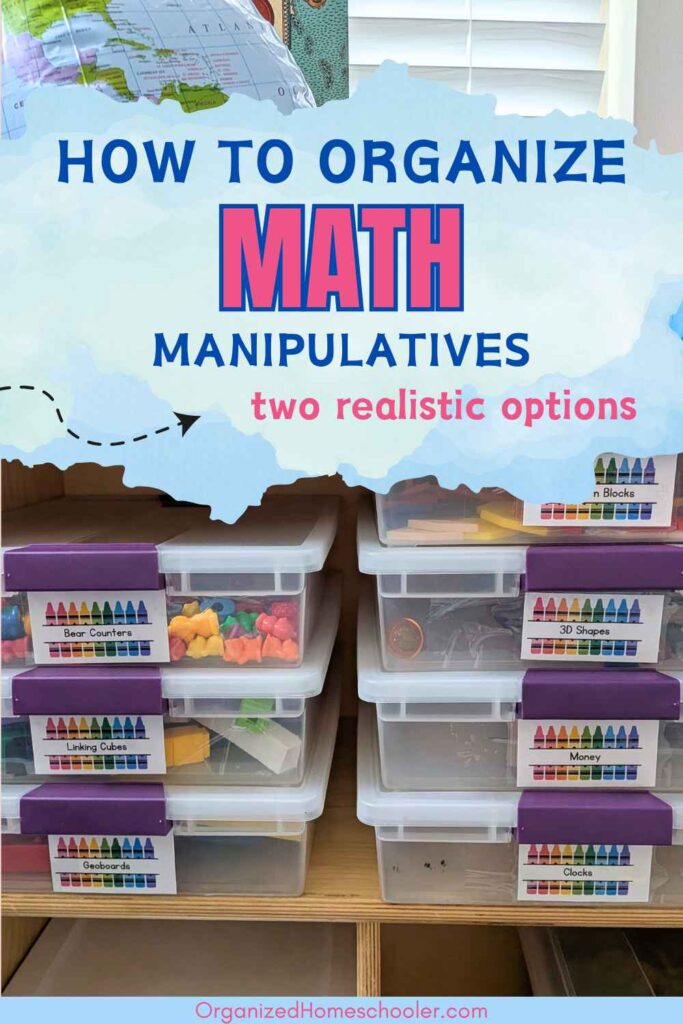
I choose to store my math manipulatives in clear lidded bins. Each math manipulative lives in its own bin. The bins are labeled and stacked on a shelf near the school area. This lets me grab exactly what we need when it is time for math lessons.
Math Manipulative Bags
If you do not have room for a shelf full of math manipulative bins, and most homeschool families don’t, then math manipulative bags might be a good alternative.
Each math manipulative gets its own zippered bag. The bag is labeled, either with a Sharpie or a label maker, so it is easy to determine which manipulative is inside. Then the bags are all put in one math bin. This keeps the math manipulatives together in one space so they are less likely to be lost, but still organized so you are not separating linking cubes from counting bears while trying to teach a lesson.
You don’t need to own every math manipulative available. Instead, choose tools that will help your child develop a deep understanding of number sense. A thoughtfully chosen collection will make math more engaging, build confidence, and provide years of hands-on learning.
Keep reading . . .
- Everything You Need to Know About Homeschooling Kindergarten
- All About Math 5 Review: Complete Guide
- Math Mammoth Review
- Homeschool Curriculum Reviews
- Hands-On Middle School Math
- Math Games Kids Will Actually Want to Play
- Math Picture Books for Kids
- Kindergarten Calendar Wall: Great Options for Home
- Math with Confidence Kindergarten: Honest Review
As an Amazon Associate, I earn from qualifying purchases.