
How to Effectively Teach Phonics in Preschool
I earn a commission from products purchased through links in this post.
One of the most common worries parents have about home education in the early years is how to teach phonics. They want their children to be confident readers, but are unsure how to teach in an effective way. They desperately do not want to do it incorrectly. As a homeschool mom and kindergarten teacher who has taught many young children how to read, let me reassure you.
You can teach phonics at home. You can teach your child how to read.
You don’t need to be an expert, but you do need to be willing to invest your time and energy. Children rarely learn to read on their own. Instead, they need consistent, explicit, and systematic instruction from a patient adult.
Over my teaching career, several parents have told me that they can’t help their child learn to read because they don’t know phonics. You do know phonics. You just might not think about the building blocks of reading because you have done it for so long that it feels like an innate skill. At its core, phonics is simply connecting sounds with letters.
Connecting sounds with letters is essential for learning how to read. Knowing each letter sound lets children connect sounds to read words. Phonics lets children figure out how to read a new word, rather than guess. Children learn that they don’t need to guess unfamiliar words because they have a strategy: look at the letters, say the sounds, and blend them. This strategy stays consistent for all words.
How to Effectively Teach Phonics in Preschool
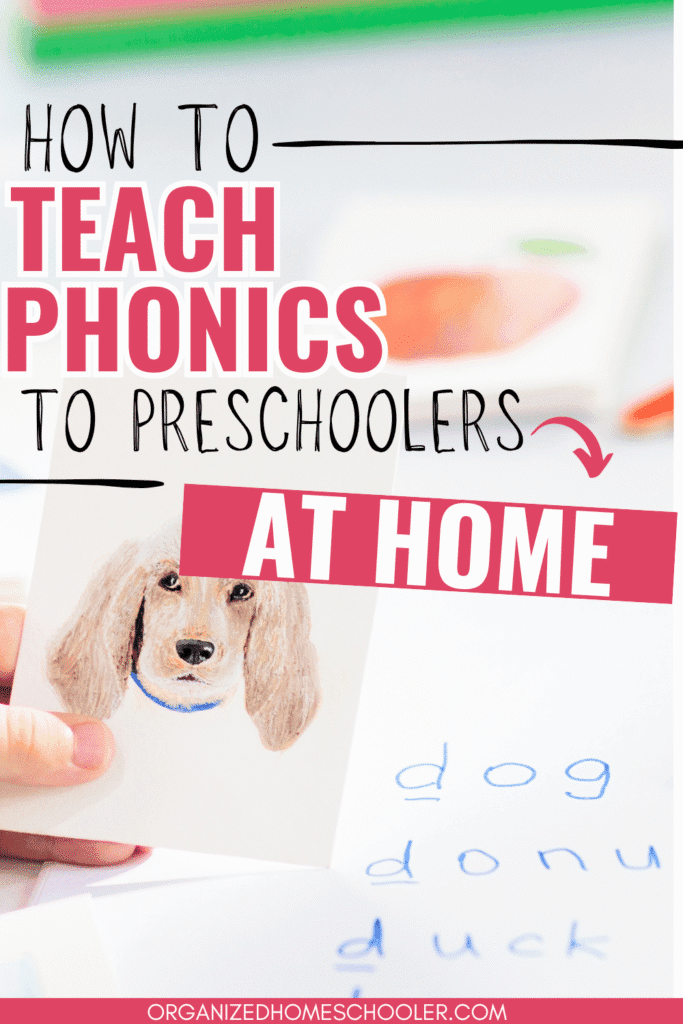
Pre-reading Skills
Before teaching phonics, it is beneficial for young children to understand a few pre-reading skills. These first steps will help build a strong foundation. A strong foundation will make it easier to teach phonics.
- Rhyming – this helps children notice patterns in words
- Understand that words are made of individual sounds – this can look like clapping syllables or slowly saying a word to stretch the beginning, middle, and end
- Identify some letters of the alphabet – matching some letter sounds with printed letters
These pre-reading skills can be taught through nursery rhymes, songs, and games. Once your child can rhyme, identify letters, and stretch words, they are ready to begin learning phonics.
3 Steps to Reading
There are three general steps to teaching children to read. Reading is the ultimate goal of learning phonics.
- Letter sounds
- Blend sounds
- Read whole words
The first step in learning to read is learning letter sounds. We start with single letter sounds. Vowels can be a little tricky because one letter produces different sounds, depending on whether it is a long or short vowel. The first vowel sound that is taught is typically the short sound because it is more predictable. Long vowel sounds are frequently part of abstract rules.
After mastering the letter sounds of individual letters, we move on to blending sounds in groups of letters. CVC (consonant, vowel, consonant) words are perfect for beginning to blend sounds. Students will eventually learn to blend digraphs, beginning sounds, and vowel combinations.
Each phonics curriculum might go with a slightly different order, but typically, we teach phonics in this order:
- Individual letter sounds, including short vowels
- CVC words (consonant, vowel, consonant – examples: bed, cat, dog)
- Digraphs (sh, ch, th, ck, etc.)
- CVCC and CCVC words (examples: deck, bath, ship, chop)
- Beginning blends
- Silent E (I always called it Bossy E)
- Long vowel patterns (ai, oa, ea, ee)
- R-controlled vowels (ar, er, ir)
This order helps young readers begin reading as soon as they know all of the letter sounds. They build on prior knowledge as they learn new phonics skills. Then they can read more complex words.
Preschoolers are not expected to master all of those phonics skills! The most important phonics skill for preschoolers is a strong understanding of individual letter sounds.
A Simple Bi-weekly Routine
A simple weekly routine to teach phonics in preschool will involve a mix of explicit instruction and review activities. Ideally, a child will learn 2 – 3 new letter sounds each week. I like to alternate new letter sound days with review days. This simple bi-weekly routine will give you a general idea of how to arrange your days. This routine does not include any subjects other than phonics lessons, but you will likely want to include those in your schedule as well.
Week One:
- Monday – Introduce a new letter and review all previously taught letters
- Tuesday – Review the new letter
- Wednesday – Introduce a new letter and review all previously taught letters
- Thursday – Review the new letter
- Friday – Introduce a new letter and review all previously taught letters
Week Two:
- Monday – Review the new letter
- Tuesday – Introduce a new letter and review all previously taught letters
- Wednesday – Review the new letter
- Thursday – Introduce a new letter and review all previously taught letters
- Friday – Review the new letter
Each day can be a bit different, but I like to spend 40-60 minutes on phonics or reading instruction each day. I know that statement is likely to ruffle some feathers when others on the internet say that they spend a total of 30 minutes a day teaching. However, in my 15 years as a homeschool teacher, I have found that spending time focusing on building a strong foundation is worth it. Make time in your day to explicitly teach phonics and set your young learners up for success. Keep reading to see my favorite phonics curriculum!
This does not need to be completed all at once. It also does not require a young child to sit for large amounts of time. I break it down like this:
- 20 minutes – introduce a new letter or review the most recently taught letter
- 20 minutes – hands-on review activities or games
- 20 minutes – reading with a parent
In real life, this might look like:
- 20 minutes of a parent-led lesson
- Take a snack break
- Do a math lesson
- Play outside for a bit
- 20 minutes of phonics review activities
- Take a lunch break
- Science activity
- History lesson
- Go to the library
- Curl up on the couch and read with mom or dad
When my children were little, that was frequently the flow of our homeschool day.
Add in Play
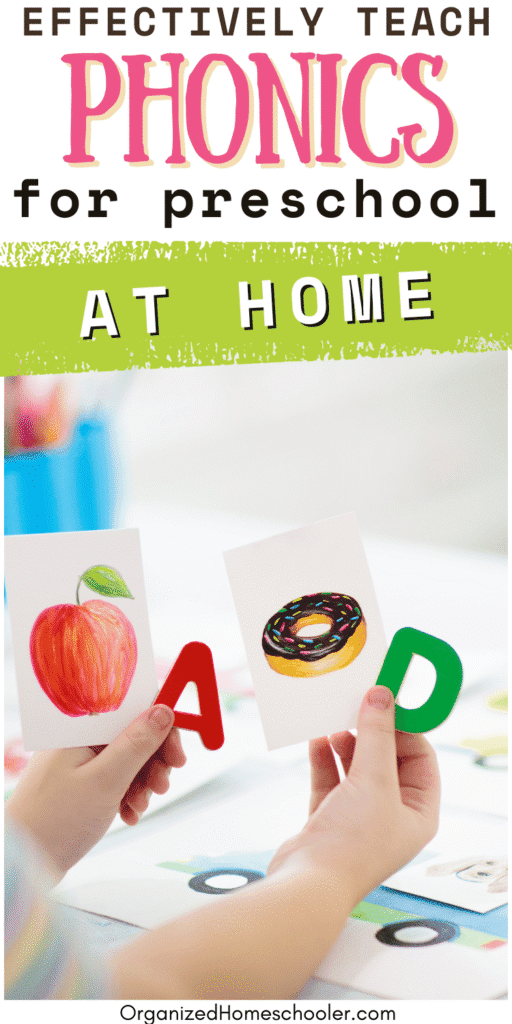
Play is an important part of learning for children. The activities selected can help teach phonics in preschool. I like to teach a new concept, such as a letter sound, with explicit instruction and then use play to review. In my opinion, combining instruction with play is the best way to keep preschoolers interested.
Some phonics activities include:
- Sound scavenger hunt – look around the house, park, or store for items with a specific beginning sound
- Letter stomp – Write letters on your driveway or sidewalk with sidewalk chalk. Then call out letters for your child to find. They will stomp on the letter. Once they have mastered identifying the letter, try calling out letter sounds.
- Build a word – Hide letters in a sand table or sensory bin. Children will find the letters and build simple words. They can begin by using notecards with the words and progress to sounding out the word on their own.
- Mystery word – Slowly sound out a word by stretching the sounds. Your child will listen carefully and then say the word. This simple activity helps with the essential skill of blending sounds.
- Play phonics board games – I always found it helpful to have a few educational board games on hand. These are a great option for days when you need another activity, but don’t have the energy to plan anything.
Want more play-based ideas? Check out this post with 14 additional language arts center activities.
Common Mistakes
There are a few common mistakes that frequently happen when people teach phonics to preschoolers.
#1 Teaching Letter Sounds Incorrectly
When I was a kindergarten classroom teacher, I frequently saw this mistake. I always found it frustrating when parents spent their hard-earned money to pay for preschool, and the kids were taught to add an ‘uh’ sound to the end of letter sounds. For example, kids were taught that the sound for the letter b is ‘buh’. That is incorrect, and it makes blending letters to read words much more difficult. To ensure you are teaching the correct sounds, utilize the free All About Learning Phonogram Sounds App.
#2 Moving Too Fast or Too Slow
Teaching young children requires a little bit of data collection. At home, this data can be as simple as intentionally observing your child during lessons and during play.
Are they excited for the lessons and mastering the material? Then keep going at the current pace. Are they excited, but mastering the material quickly? Consider going through the lessons a little faster. Are they frustrated? That requires more evaluation. Are they frustrated because the material is too easy and they are bored? Then go faster or sprinkle in more challenging activities. Are they frustrated because the material is too hard right now? It is okay to slow down. Slowing down can look like pausing new lessons while reviewing previous material through systematic review or games and activities.
Classrooms typically move at the average, or the expected, speed. Teaching at home allows you to tailor the lesson speed to your child’s progress.
#3 Not Celebrating Effort
Teaching a class of children and homeschooling a small group are obviously different, but one thing I noticed is consistent: children love to have their effort celebrated. Learning is hard work, and preschoolers are learning all day long. They are learning to navigate relationships with their friends and family, they are learning to dress themselves, they are learning to communicate their wants and needs in an appropriate way, and they are learning academic skills. It is a lot for little ones!
People often celebrate when a child masters a big skill, such as reading a word or a short sentence independently. Celebrating the effort helps young children keep trying even when learning is hard. Letting children know that you see how hard they are working can boost their spirits and make them want to try again.
Celebrating effort doesn’t require grand gestures. Some ideas that I have found successful are:
- Letting the student choose a sticker from a special sticker basket
- Giving the student a ‘smelly’ bookmark
- Offering encouraging words (“Wow! You tried so hard! I can tell you have been paying attention.” or “I love the way you _________.”)
#4 Relying on Sight Words
While some curricula include sight words, word recognition has fallen out of favor as more has been learned about the science of reading. Sight words require readers to memorize whole words. Phonics teaches children how to decode new, unfamiliar words.
My Favorite Curriculum to Teach Phonics
When I sat down to write this article, I spent quite a bit of time reviewing phonics curriculum options. I wanted to research as many phonics programs as possible to make sure I was recommending only the best. I admit, I am hard to please when it comes to curriculum for our youngest learners. I want it to be engaging, but also effective. I want children to enjoy the lessons, and I want the lessons to be easy to teach. The curriculum needs to help you effectively teach phonics through a systematic approach.
My homeschooled children are now homeschool adults, but I remember how busy the days with little ones can be. Parents of preschoolers need a curriculum that is well-designed and effective.
All About Reading is always my recommendation when anyone is looking for a reading curriculum. The curriculum is based on the science of reading, features short daily lessons, requires very little prep time from parents, and includes hands-on activities. It provides systematic phonics instruction.
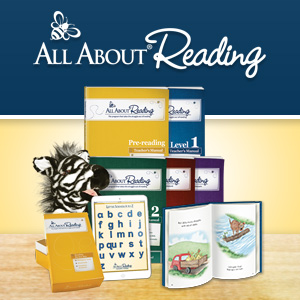
Each pre-reading lesson contains ‘a letter of the lesson’ with print and hands-on activities, a language exploration activity, and read-aloud time. I think this format is perfect because it is a gentle way to introduce phonics to preschoolers. They receive the explicit instruction necessary to learn a new skill, combined with hands-on activities and games, all in a short lesson. The lesson can even be split up with the ‘letter of the lesson’ activities and language exploration activity being done at one time, and the read-aloud time completed at another time.
After completing the All About Reading Pre-Reading curriculum, students will be able to:
- Identify uppercase letters
- Identify lowercase letters
- Say the sound associated with each letter
- Begin to blend sounds
- Clap syllables
- Identify rhyming words
- Identify the initial sounds and ending sounds in words
- Answer simple questions about a story
- Retell a story
The All About Learning website offers a digital preview of every component of the Pre-Reading curriculum. You can see parts of the table of contents, scope and sequence, teacher’s manual, activity book, and both reading books.
If I ever get the opportunity to homeschool little ones again, this is absolutely the reading curriculum I will purchase.
Vocabulary Terms
I think part of parents’ hesitation to teach reading is being intimidated by unfamiliar academic words.
Phonological awareness – Phonological awareness is the most basic building block of reading. It is when children can hear and identify sounds in a spoken word. This can be parts of words, like when children identify rhyming words.
Phonemic awareness – Phonemic awareness is the ability to hear, identify, and manipulate individual letter sounds. This is a step past phonological awareness because it focuses on the individual phonemes.
Phonemes – A phoneme is an individual sound in a word. This includes individual letters and letter combinations.
I hope this article reassures you that it is possible to effectively teach phonics at home.
Keep reading . . .
- How to Homeschool Preschool: The Complete Guide for Parents
- The Top Pre-K Homeschool Curriculum Options
- 6 Fun Summer Lesson Plans for Preschool
- Educational and Fun Dinosaur Activities for Preschool
- Educational Preschool Toys
- Calendar Wall Options for Home
- The Best Math Manipulatives
- Homeschool Kindergarten: Your Complete Guide to Teach Your Kindergartener at Home
As an Amazon Associate, I earn from qualifying purchases.