
Guide to the Best Kindergarten Homeschool Curriculum Options
I earn a commission from products purchased through links in this post.
Over my 15 years of homeschooling, I have been in a lot of homeschool groups on social media. Parents of soon-to-be kindergarteners frequently want to know the best kindergarten homeschool curriculum. Without fail, people flood the comments with suggestions to skip all formal education until age 7 or 8. I vehemently disagree with that well-meaning advice.
That might work for some people, but I worry that these excited new homeschool parents are left feeling like they are doing something wrong by wanting a formal curriculum for their kindergarten students.
Let me reassure you. It is okay to use a kindergarten homeschool curriculum.
I’m sure that many people think that my professional experience as a kindergarten teacher is skewing my opinion, and maybe it is. I, of course, used a reading curriculum in my kindergarten classroom. A well-designed curriculum is one of the best ways to make sure that foundational skills are not forgotten. It also makes sure that information is taught correctly. I frequently needed to reteach information, such as letter sounds, because parents, preschools, and daycares taught the sounds incorrectly.
While I did use the required curriculum for teaching core subjects, I was allowed to supplement the material. I studied the standards the students were expected to learn, and then I added in as many hands-on activities, stories, and extras as possible. The result was a kindergarten program that helped students master the material while preserving a joy for learning.
Now, if you don’t want to use a kindergarten homeschool curriculum, you don’t have to. There is a lot of flexibility in homeschooling, especially in the early years. You have the freedom to do whatever works best for your children. You also have the responsibility of providing an education. This should not be taken lightly. All children deserve an exceptional learning experience.
Even if you plan to homeschool from kindergarten through high school graduation, I think it is wise to make sure that your children are always ‘on grade level’. Life can change quickly and in unexpected ways. I have seen families need to suddenly enroll their children in traditional schools due to divorce, illness, financial changes, etc. Schools have full discretion regarding student placement and will typically test incoming homeschool students to help them decide which grade level to place them. This sudden and unexpected life change will be even more stressful if you are unsure that your child is prepared for the grade.
Before you listen to more of my advice, let me tell you a bit about myself. I was a kindergarten teacher before my children were born. I loved my time in the classroom, but decided to stay home with my children. When my daughter was in first grade, we had a negative public school experience and decided to give homeschooling a try. My entire family fell in love with homeschooling, and when my youngest turned 5, he joined our homeschool. I have homeschooled kindergarten through high school. Both of my children began college classes at 16 and are now full-time college students. I spent a few more years as a classroom kindergarten teacher. I adored teaching kindergarten, but I frequently heard from parents that they wished they could homeschool. They just didn’t know how to get started. Homeschooling was an amazing experience for my family, and I want to help other families learn how to blend rigor and play so they can have the same experience.

Guide to the Best Kindergarten Homeschool Curriculum Options
There are a few benefits to using a kindergarten homeschool curriculum:
- Sets a solid academic foundation
- Gives structure to the day
- Makes planning easier
- Offers peace of mind that you are ‘on track’
How to Choose a Kindergarten Homeschool Curriculum
Researching homeschool curricula can be really overwhelming. There are so many options!
The key to selecting curriculum choices that work for your family is to pay careful attention to a few points.
Price – Decide ahead of time what you can comfortably afford to spend. There are options that are free and options that are hundreds of dollars. Knowing what you can realistically afford lets you eliminate the ones that are too expensive. Typically, a free kindergarten homeschool curriculum will require you to spend more time planning and prepping for the lessons. You will frequently need to add activities to make the program more robust. More expensive doesn’t necessarily mean better, though.
Box curriculum or individual subjects – You have the choice of selecting a boxed kindergarten homeschool curriculum or a curriculum for just certain subjects.
A boxed curriculum typically means that all of the subjects are covered in one plan, aka a complete kindergarten curriculum. This can make planning really easy, but it limits your ability to easily customize your child’s kindergarten year.
Selecting curricula for individual subjects allows you to pick and choose whatever curriculum looks like a good fit for each grade, but it requires a little more research and planning. It does help you create a more customized homeschool.
Learning style – The main learning styles are:
- Auditory (Aural) – Auditory learners learn by hearing information. Listening to books read aloud is one way they learn.
- Visual (Spatial) – Visual learners learn by seeing the information. They frequently benefit from pictures and graphs.
- Read/Write – Read/Write learners by reading and writing (the name kind of gives it away). Writing notes and reading them are helpful ways of processing information.
- Kinaesthetic (Tactile) – Kinaesthetic learners are hands-on learners. They need to ‘do’ things to really understand.
Don’t worry if you don’t know which learning style best fits your kindergartener. Most learners benefit from having instruction presented in a variety of ways.
However, it helps to keep your specific child in mind when selecting a curriculum. We want learning to be a positive experience, so we wouldn’t expect a small child who loves to be on the move to sit quietly with a pencil for long stretches of time. At the same time, some little ones love the idea of workbooks. You know your child best.
Teaching style – Your teaching style or preferences matter too. Consider:
- Do you want online lessons?
- Do you want to bring home a stack of library books each week?
- Do you have the time for planning, or do you need to open the book and start teaching immediately?
Homeschool style – There are a few different homeschool styles, too.
- Classical – Classical education relies on a three-part process for learning. The grammar stage, elementary school, is when students absorb information. The logic stage, middle school, is when students begin to think analytically. The rhetoric stage, high school, is when students can apply abstract thought to everything they learn. There is often a focus on poetry and classic literature.
- Traditional – Traditional homeschool education follows the structure of a classroom. There is typically a dedicated school room, textbooks, and workbooks from a packaged curriculum, and a set daily schedule.
- Charlotte Mason – A Charlotte Mason homeschool follows three core parts: atmosphere, discipline, and life. There is a focus on developing good habits. The school day includes living books, narration, copywork, time outdoors, and artist studies. A living book is a book that is written like a story, encourages a love for the subject, and sparks imagination.
- Eclectic – An eclectic homeschool blends all of the methods, choosing what works best for their family. This is the homeschool method I followed. Sometimes we used classical curricula. Other times, we used textbooks or workbooks. We always added tea with poetry and time outside to our homeschool schedule.
Secular or religious – A secular curriculum does not align with or mention any specific religion, while a religious curriculum does.
Related: 50+ of the Best Secular Homeschool Curriculum Choices
Educational goals – What does a successful kindergarten year look like to you? What would you like your child to know at the end of the school year? What would your child like to learn?
My Favorite Kindergarten Curriculum Choices
Please know that even if you decide to use a kindergarten homeschool curriculum, you do not have to use one for every subject area. It is okay to choose to use a curriculum for some subjects and not for others.
I do recommend using a phonics curriculum unless you have experience teaching kids to read. The curriculum can be a really helpful guide to prevent frustration for parents and children.
You will notice that for some subjects, I have several favorite kindergarten homeschool curriculum choices. For other subjects, I don’t have as many suggestions. This is because some of my favorite curriculum companies don’t offer kindergarten products.
Note: Don’t see your favorite kindergarten homeschool curriculum on the list? That is okay! It might still be a great curriculum. If it works for your family, then it is a great choice! Leave your favorite kindergarten curriculum recommendations in the comments.
Phonics
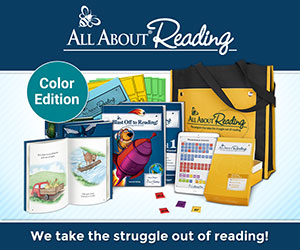
All About Reading – All About Reading is a secular, easy-to-use, multi-sensory homeschool reading curriculum. The lessons are intentionally designed to be short to keep interest levels high and frustration low. The lessons are somewhat scripted, which means there are detailed and easy lesson plans for parents to follow. If I had to pick one kindergarten homeschool curriculum to recommend, it would be All About Reading.
Kids will learn phonics and vocabulary while also focusing on comprehension. After all, reading doesn’t really do any good if kids don’t understand or remember what they read.
The All About Reading Pre-Reading Level is the first level of the program. In this level, students learn to recognize uppercase and lowercase letters and letter sounds. If your child can not confidently identify letters and their sounds, this might be the best place to start.
In All About Reading Level 1, students will begin blending sounds to read. If your child knows most of the letters and their sounds, this might be the best place to start. Read this detailed All About Reading Level 1 review to see if it seems like the right curriculum for your child.
I think it is always a good idea to do a quick placement test (available on the site). Note that the program levels do not equate to grade levels. If you do discover that you have the wrong level, All About Reading offers a one-year money-back guarantee.
I like that this program systematically guides parents through teaching their children to read with a blend of direct instruction and hands-on activities.
All About Learning has a great page full of free resources. Definitely check it out for free printable language arts games and activities.
Related: All About Reading vs Teach Your Child to Read in 100 Easy Lessons
Language Arts
Rabbit Trails Through Literature – Rabbit Trails Through Literature is a religious literature-based language arts curriculum. It does not teach children letter recognition, how to read, but it does teach other language arts topics such as grammar, vocabulary, and copy work.

I like that Rabbit Trails Through Literature incorporates kid-friendly literature and hands-on activities to make learning fun. Kindergarten lessons should definitely be fun!
Rabbit Trails offers a few free lesson plans. These are a great way to determine whether or not a curriculum is a good fit for your child.
Related: Gentle Teaching With Rabbit Trails Curriculum
Handwriting
If you want to add handwriting to your kindergarten homeschool curriculum, I recommend using workbooks rather than an expensive program.


Last update on 2026-09-18 / Affiliate links / Images from Amazon Product Advertising API
The things I have noticed that actually improve handwriting in young children are:
- Proper pencil grip
- Lined paper
- Improving fine motor skills
- Taking the time to write letters slowly
Writing
Writing is not typically part of a kindergarten homeschool curriculum. However, if your child recognizes letters and knows most letter sounds, they might be ready for some gentle writing instruction.
Scribbles to Stories – Scribbles to Stories is a sequential writing curriculum designed specifically for kindergarten. Students begin by drawing pictures and then move on to labeling. I really like the way the program provides scaffolding to help the children develop specific writing skills.
This program also includes suggested book lists that highlight the skill being taught. Many of the classic stories are available at libraries or on YouTube.
Related Post: Everything You Need to Know About Teaching Kindergarten Writing
Math
Math with Confidence – Math with Confidence is a math curriculum I wish had existed when my own kids were younger. It is so important to give kids a strong foundation without creating math anxiety. These lessons are quick, which is perfect for short attention spans. The teacher’s guide will give you all the information you need to confidently teach kindergarten math skills. You need the teacher’s guide and the student workbook.

Last update on 2026-09-20 / Affiliate links / Images from Amazon Product Advertising API
I like that each week, there is a math picture book in the lesson plans. This can help kids realize that math is all around us. It is part of our everyday lives and isn’t something to be feared.
I also appreciate that the curriculum plans for 4 days of math instruction per week. This gives you one day a week to go on field trips, have park days, or just catch up on errands without worrying about falling behind in math.
Math with Confidence is a bit on the easy side of kindergarten math curriculum options, but that’s totally okay if you want a gentle introduction to formal math lessons.
Related Post: Math with Confidence Kindergarten: Honest Review
All About Math – All About Math is a sequential elementary math program. The lessons only take about 20 minutes a day and include an effective blend of direct instruction and hands-on activities. The detailed lesson plans take all of the guess work ot of teaching math.

I love that every aspect of the program was intentionally designed – right down to the font.
Most young learners will begin in Level 1. Their webpage makes it easy to see what is taught, the Table of Contents, Scope and Sequence, a sample of the Teacher’s Manual, and a sample of the Activity Book.
Science

Last update on 2026-09-20 / Affiliate links / Images from Amazon Product Advertising API
Sassafras Science Adventures – Sassafras Science Adventures is a secular science curriculum for elementary-grade-level kids. There are 6 different volumes to this series:
- Volume 1: Zoology
- Volume 2: Anatomy
- Volume 3: Botany
- Volume 4: Earth Science
- Volume 5: Geology
- Volume 6: Astronomy
The volumes are written in novel format to keep kids interested. There are also student science logbooks and activity guides for each volume
I like that Sassafras Science Adventures combines storytelling with information and hands-on activities. They even offer an experiment kit that contains most of the supplies needed for the experiment. I know that I am always more likely to actually do the experiments if the supplies are already in my house!
Rabbit Trails Through Science – The Rabbit Trails Through Science curriculum is very similar to the Rabbit Trails Through Language Arts curriculum mentioned above. It is a religious elementary science curriculum that is literature-heavy. Students will listen to great children’s books and complete hands-on activities to learn about the world around them.
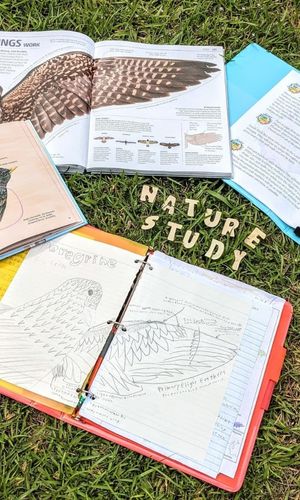
The volumes include:
- Birds
- Reptiles and Amphibians
- Space
- Biomes
These volumes can be used in any order, so that you can choose whatever your child is interested in at the time.
I like the hands-on nature of Rabbit Trails Through Science. Building unit studies with quality books and engaging activities is exactly how I taught science when I was a classroom kindergarten teacher. The volumes are designed to be used as a family, so this curriculum can be used with your kindergartener and older children at the same time. Rabbit Trails Through Science does all of the planning for you! Rabbit Trails Homeschool also offers social studies and history units.
Social Studies
It is hard to find a kindergarten homeschool curriculum for social studies! There are not very many options, and it makes sense when you look at common kindergarten standards. Honestly, social studies isn’t really considered one of the core subjects for kindergarten. Most history homeschool curricula begin in 1st grade, but can be adapted to use in kindergarten.
That doesn’t mean that you can’t teach social studies or history, though.
The best way to teach social studies to young children is to figure out what they are interested in. Everything has a history that can be studied. I recommend choosing a few time periods or events that you or your kids find interesting and putting together your own unit study.
If you really want to use a traditional history curriculum in your homeschool, check out Core Knowledge.
Core Knowledge is one of the few options specifically for kindergarten. I used this program when I was a classroom kindergarten teacher. One of the best things about Core Knowledge is that the digital resources are completely free. Everyone has access to a teacher’s guide with lesson plans, printable worksheets, and the student textbook. Kindergarten history is broken into 4 units:
- Let’s Explore Our World
- Native Americans
- Exploring and Moving to America
- The Mount Rushmore Presidents
This program can feel a bit dry, but it is a fantastic resource to form the spine of a history unit study. I recommend incorporating the books suggested in the teacher’s manual and adding in as many additional resources and hands-on activities as possible.
Frequently Asked Questions about Kindergarten Homeschool Curriculum
Are there free curriculum options?
Yes, there are free options available. One of the most famous free homeschool curriculum options is Easy Peasy Homeschool. I generally think it is a little light, but every family is different.
Related: Free Homeschool Resources
How much time should we spend on kindergarten homeschool work?
It really does not take much time to homeschool kindergarten. A homeschool kindergarten day is drastically shorter than a classroom kindergarten day. There is a huge difference between teaching and managing one child versus 20. I frequently see parents recommending spending no more than 30 minutes a day doing homeschool lessons with kindergarteners. I think that is doing those children a huge disservice. It takes time to give students a strong academic foundation.
My preferred kindergarten homeschool schedule was:
- 20 minutes phonics lesson
- 20 minutes language arts centers (hands-on activities)
- 20 – 30 minutes of math
- 20 minutes of science
- 20 minutes of history
- Unlimited reading time
This is less than two hours a day. Note that this does not need to happen back-to-back or in this order. You can spread it through your day however works best. Of course, be aware of your state’s legal requirements for homeschooling, but most states are pretty reasonable for kindergarten.
This leaves plenty of opportunities for playing with friends, playing, going to the local library, doing art projects, going on walks, enjoying creative play, trying out foreign languages, or whatever your kids enjoy.
Which subjects should we cover?
The core of a solid kindergarten homeschool curriculum is phonics and math. In my opinion, those two subjects should be taught 4-5 days per week. Then you can add in handwriting, writing, science, and history as you like. You can also add in any electives that make your children excited to homeschool.
I hope this blog post helps you feel confident in choosing the best curriculum for your family. Kindergarten is an exciting time! Taking control of your child’s education can feel intimidating, especially the first time, but it can also be the beginning of a beautiful homeschooling journey.
Strong Foundations Homeschool Partnership
If you are looking for a homeschool mentor and kindergarten homeschool enrichment classes in the Raleigh, North Carolina area, check out my program, Strong Foundations Homeschool Partnership. I teach kindergarten classes a few days a week from my home in Apex, NC. I combine hands-on activities with direct instruction to teach reading, math, writing, science, and social studies. The tuition includes homeschool mentoring services. We create a partnership that will help your kindergartener have an amazing year.
Keep reading . . .
- Homeschool Kindergarten: Your Complete Guide to Teach Your Kindergartener at Home
- What to Teach a Kindergartener at Home
- Everything You Need to Know About Teaching Kindergarten Writing
- Secular Homeschool Curriculum Options for Every Grade
- How to Homeschool First Grade: What Do I REALLY Need to Teach?
- Best Preschool Homeschool Curriculum Options for Balance
- The Best Math Manipulatives for Homeschool
- Kindergarten Calendar Wall: Great Options for Home
- How to Homeschool on a Budget
- Current Homeschool Deals and Sales
As an Amazon Associate I earn from qualifying purchases.